S&P 500 futures: 3 hidden truths that make them risky
S&P 500 futures are not a forecast of the open. Here is the real math on ES vs MES, why margin misleads beginners, and the 60/40 tax rule nobody mentions.


At 10:18pm ET on 2 September 2026, S&P 500 futures were quoting 7,638.25. The index those contracts track had closed that afternoon at 7,663. Same market, two numbers, 25 points apart, and nobody found that strange.
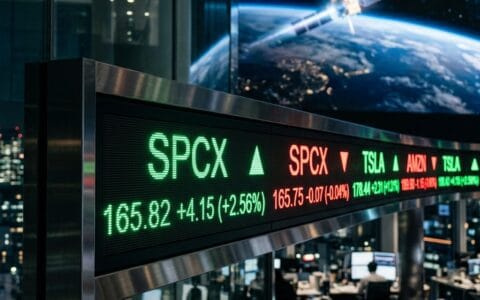
The number scrolling under the anchor at 6am is not a forecast of where stocks will open. It is a live price on a leveraged contract, and most of the gap between it and the index is arithmetic, not opinion. Once that clicks, three things about S&P 500 futures stop being confusing and start being useful.
What S&P 500 futures actually are
An S&P 500 futures contract is a standardised agreement, traded on the CME Group exchange, to settle the difference between your entry price and where the index lands on expiry day. There is no basket of shares changing hands. Index futures are cash settled, so nothing is ever delivered to you. Contracts expire quarterly, on the third Friday of March, June, September and December.
The reason the futures price sits above or below the index is cost of carry. Holding the actual 500 stocks means paying to finance them and collecting their dividends, so the futures price bakes in the financing rate minus the dividend yield, and that premium shrinks to nothing as expiry arrives. It works like an airline seat priced three months out. The fare reflects what it costs to hold the seat until then, not a prediction about the weather on the day.
One point is $50, and that is the whole story
Every explainer lists the multiplier and moves on. S&P 500 futures come in two sizes, and that multiplier is the entire risk profile.
The E-mini contract, ticker ES, is worth $50 per index point. Its smallest move is a quarter of a point, which is $12.50. At 7,638.25 that means one ES contract carries $381,913 of S&P 500 exposure. The Micro E-mini, ticker MES, is one tenth of that: $5 a point, $1.25 a tick, and $38,191 of exposure.
Here is where beginners get ambushed. Exchange margin on these contracts runs near 5% of notional value, so roughly $1,900 opens a Micro. Think of a car rental deposit. The deposit is not the price of the car, and margin is not the size of your position.
Put $38,191 of an S&P 500 ETF next to one MES contract. A 1% index move is 76.4 points, which pays or costs $382 either way. Identical outcome, wildly different bill.
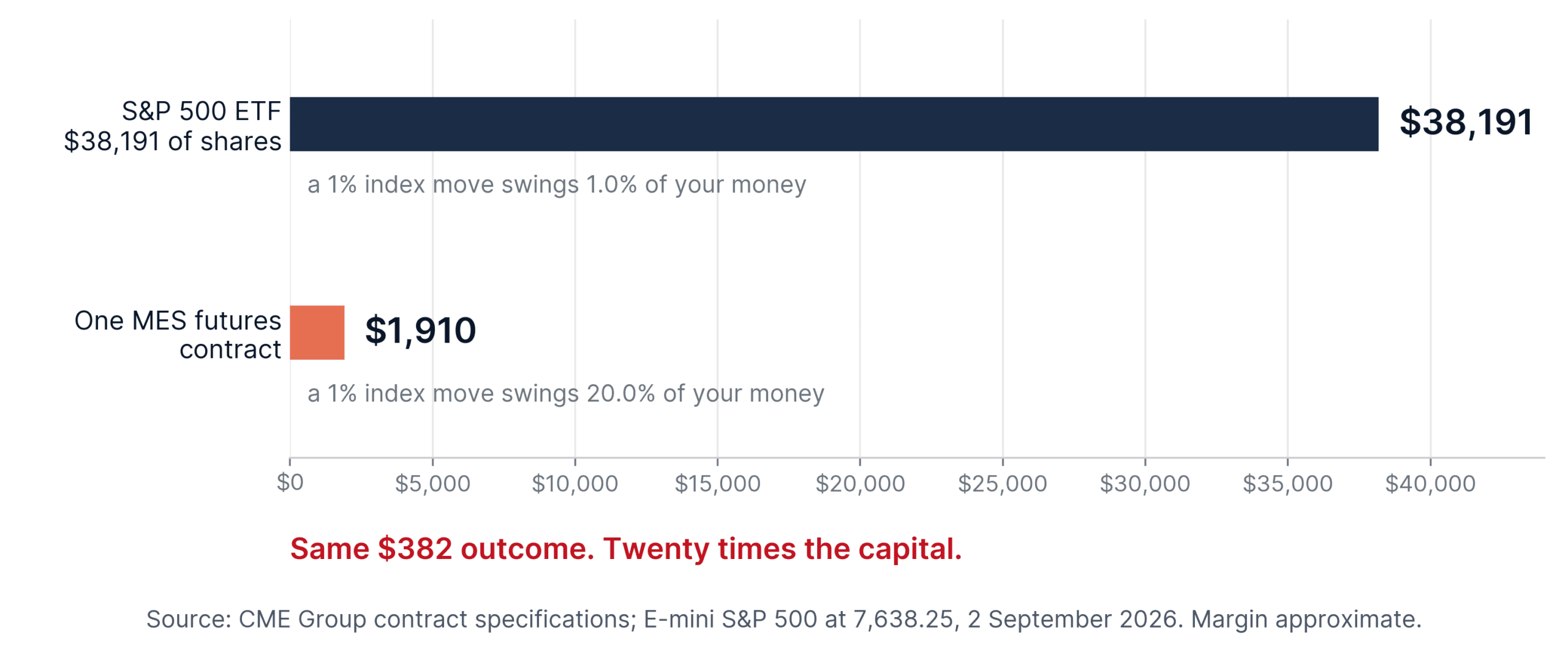
The ETF buyer risked 1% of their capital on that move. The futures trader risked 20% of theirs. Same $382.
ES vs MES: same leverage, smaller bill
Micro S&P 500 futures get sold as the beginner-friendly option, and that is half true. They are smaller. They are not less leveraged, because the ratio of margin to notional value is identical. A Micro simply lets you be wrong in $5 increments instead of $50 ones.
| E-mini (ES) | Micro E-mini (MES) | S&P 500 ETF | |
|---|---|---|---|
| Value per index point | $50 | $5 | n/a |
| Minimum tick | 0.25 pt = $12.50 | 0.25 pt = $1.25 | $0.01 per share |
| Exposure at 7,638.25 | $381,913 | $38,191 | Share price paid |
| Cash to open | Around $19,000 | Around $1,900 | Full value |
| Trading window | Sun 6pm to Fri 5pm ET | Sun 6pm to Fri 5pm ET | US market hours |
| Expiry | Quarterly, cash settled | Quarterly, cash settled | Never |
| US tax treatment | Section 1256, 60/40 | Section 1256, 60/40 | Normal capital gains |
If your goal is owning the index for twenty years, S&P 500 futures are the wrong tool entirely, and my breakdown of VTI, VOO and SPY is the more useful page.
Why S&P 500 futures never really close
S&P 500 futures trade from Sunday 6pm ET to Friday 5pm ET, with a daily maintenance break. That near-continuous session is why futures quotes exist at 3am when the stock market is dark.
It also matters more than it sounds. Research by Dong Lou, Christopher Polk and Spyros Skouras, published in the Journal of Financial Economics in 2019, found that nearly all long-run gains accrue overnight. A New York Fed staff report on the overnight drift reached similar conclusions. The hours most investors sleep through have historically carried the returns.
That is not a reason to trade at 3am. It is a reason to stop treating the pre-market print as noise, and equally to stop treating it as a signal. I covered the same trap with the ticker everyone checks first in the most-watched market data nobody actually needs.
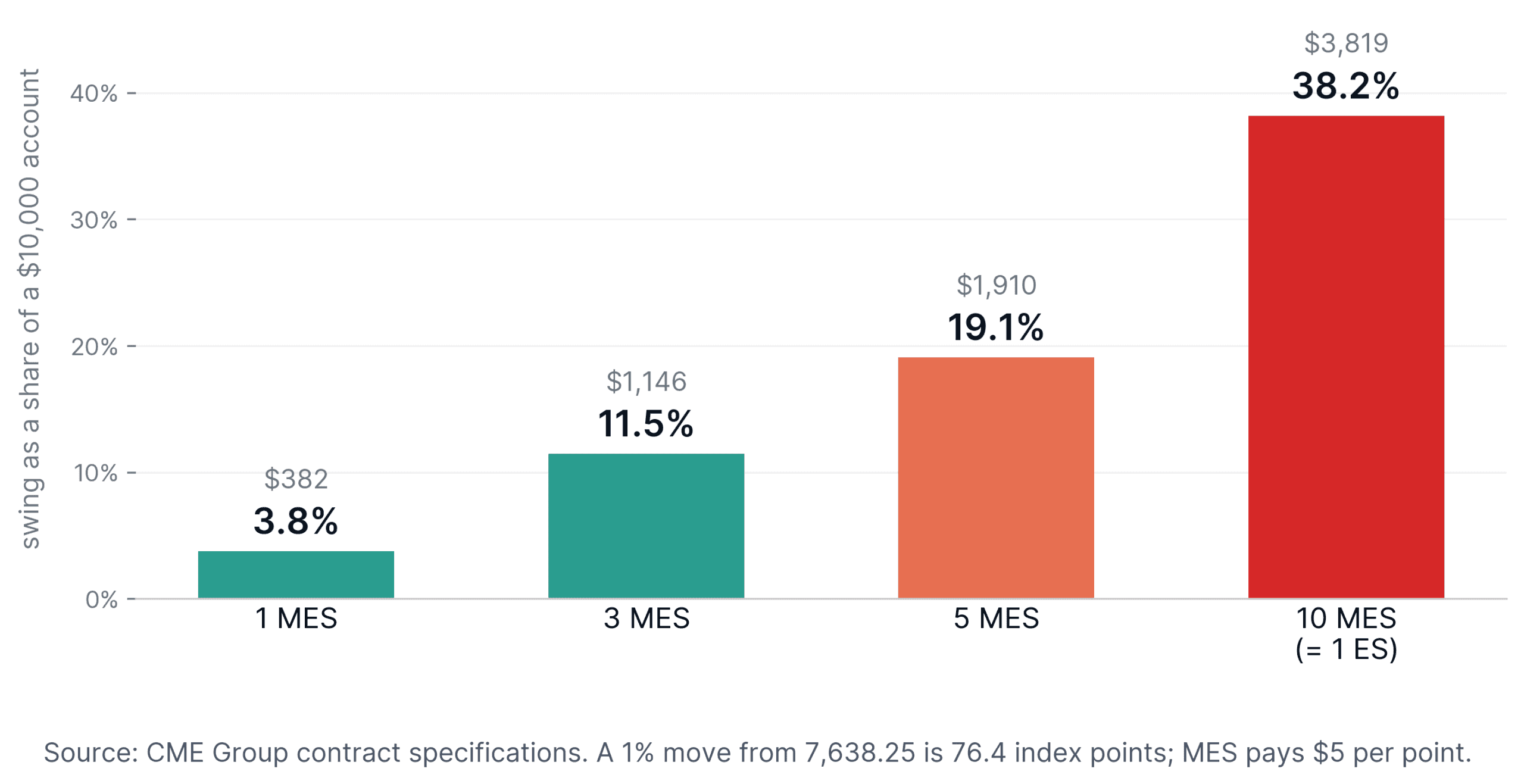
Position size, not the contract you pick, decides whether a normal Tuesday is survivable.
The 60/40 tax rule beginner guides skip
This one is genuinely underrated. In the US, S&P 500 futures fall under Section 1256, and the treatment is unusual. Every gain or loss is split 60% long term and 40% short term regardless of how long you held it, even if the trade lasted nine minutes. You report it on IRS Form 6781 rather than tracking every trade individually.
For an active trader that blend usually beats the all-short-term rate applied to stock trades. There is a catch worth knowing. Open positions are marked to market on the last business day of the year and taxed as if you closed them. Section 1256 losses also carry back three years against prior 1256 gains, which no equity account offers.
Outside the US this is irrelevant. UK and EU readers face their own rules, and futures generally sit outside an ISA or a SIPP entirely.
Who should actually trade S&P 500 futures
Honest answer: people hedging a portfolio they already own, and disciplined short-term traders who have survived a losing year. Almost nobody else.
Nothing here forecasts where S&P 500 futures settle in September. I do not know, and neither does anyone quoting a number at you before breakfast. What the pre-market print does tell you, reliably, is the cost of carrying the index until then. If you want S&P 500 exposure without the margin call, a $25 starting plan gets you there slower and keeps you solvent.
The contract is not the risk. Your size is.
Sources
- CME Group, E-mini S&P 500 Futures Contract Specifications (2026) (cmegroup.com)
- CME Group, Introduction to Equity Index Products: What Is Equity Index Basis (cmegroup.com)
- Internal Revenue Service, About Form 6781: Gains and Losses From Section 1256 Contracts and Straddles (irs.gov)
- Lou, Polk and Skouras, A Tug of War: Overnight Versus Intraday Expected Returns, Journal of Financial Economics (2019) (sciencedirect.com)
- Boyarchenko, Larsen and Whelan, The Overnight Drift, Federal Reserve Bank of New York Staff Report No. 917 (newyorkfed.org)
Keep learning: browse all our investing guides.

Arpit Soni
Founder and Editor in Chief
Thewealthora was started to do one thing: take the money questions people actually ask and answer them in plain English, with the arithmetic shown and the catch stated rather than buried.