

Compound interest calculator with monthly contributions
This compound interest calculator shows how a starting amount plus a regular monthly contribution snowballs over time, whether you save $50 or $5,000 a month. Compound interest is the most powerful idea in personal finance, because your returns start earning returns of their own.
What is the compound interest calculator?
A compound interest calculator estimates the future value of money that grows on itself. Unlike simple interest, which only ever pays on your original deposit, compounding pays interest on your interest as well, so the balance curves upward instead of rising in a straight line. This tool compounds monthly, which matches how most savings accounts, index funds and regular investment plans behave in practice.
How the compound interest calculator works
A = P × (1 + r/n)^(n×t)- A: final amount
- P: starting principal
- r: annual return rate (as a decimal)
- n: times compounded per year (12 here)
- t: number of years
Worked example
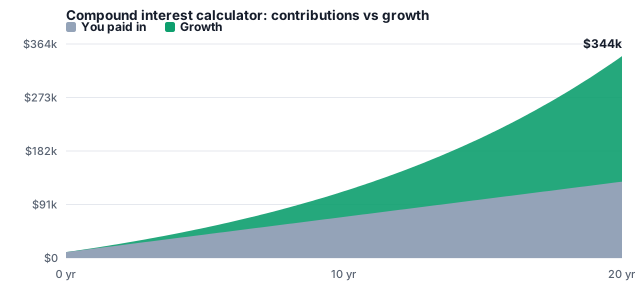
Put in $10,000 today, add $500 every month, and assume an 8% annual return. After 20 years the calculator projects about $344,000. Of that, $130,000 is money you actually paid in and roughly $214,000 is growth. That gap is compounding doing the heavy lifting, and it widens the longer you leave it alone.
How to use it
- Enter your starting amount and how much you will add each month.
- Set a realistic annual return rate, then the number of years.
- Adjust the inflation field to see the result in today's spending power.
- Read the donut to see how much is contributions versus growth.
Good to know before you rely on it
- The result is a smooth average path. Real returns arrive unevenly, so short periods will wobble well above and below the line.
- Compounding frequency matters: monthly compounding beats annual on the same rate, which is why this tool uses monthly.
- Fees quietly eat compounding. A 1% annual fee can cost a large slice of the final balance over decades, so check the expense ratio of whatever you invest in.
- Starting earlier usually beats saving more later, because the earliest contributions compound the longest.
Why Thewealthora’s compound interest calculator is different
- See the result in today's money too, so inflation never quietly hides the real number.
- Type an exact figure or drag the slider, whichever is faster for you.
- A live donut splits what you put in from what the market added.
Pair it with the monthly investment calculator, the savings goal calculator, or open live markets and our investing guides.
Sources and further reading
For the underlying concepts, see the U.S. Securities and Exchange Commission compound interest calculator.
Frequently asked questions
What is compound interest in simple words?
Compound interest means you earn returns on your returns. In year one your money earns interest, and in year two that interest also earns interest. Over decades this snowballs, which is why starting early tends to beat starting big.
How often is interest compounded in this calculator?
Monthly, which matches how most savings accounts, index funds and systematic investment plans actually grow.
What return rate should I use?
A common long-term reference is 7 to 10 per cent a year for broad stock index funds before inflation, and 3 to 5 per cent for safer fixed-income options. Lower your assumption if you want to be conservative.
Is compound interest guaranteed?
No. Real market returns vary year to year. The calculator shows a smooth average path, so actual growth will wobble around it, especially over short periods.
This tool is for education, not personalised financial advice. Results are projections based on your inputs, not guarantees.
More free tools
Keep going: check live stock market prices, read our investing guides for beginners, or catch up on today's finance news.