

Savings goal calculator: how much to save each month
This savings goal calculator works backwards from your target, whether a house deposit, an emergency fund or a wedding, and tells you the exact monthly amount to save to get there on time, including the growth earned along the way.
What is the savings goal calculator?
A savings goal calculator solves the future-value formula in reverse. Instead of asking what a monthly amount grows into, it starts from the amount you need by a fixed deadline and works out the monthly contribution that closes the gap, after accounting for growth on what you have already saved. It is the fastest way to turn a vague ambition into a concrete monthly habit.
How the savings goal calculator works
Monthly = (Goal − Savings × growth) × i / (growth − 1)- Goal: the target amount
- Savings: what you have already put aside
- growth: (1 + i)^n compounding factor
- i: monthly return rate, n: months to the deadline
Worked example
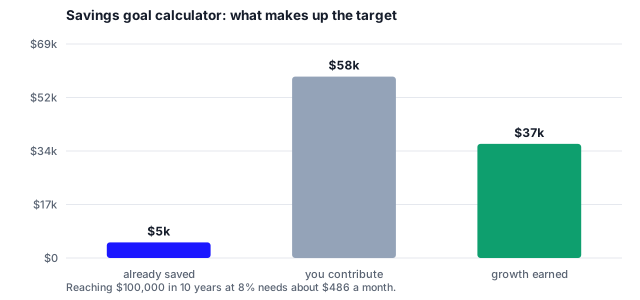
You want $100,000 in 10 years and already hold $5,000, expecting 8% a year. The calculator finds you need to save around $520 a month. Of the final total, a little over $60,000 is money you contribute and the rest is growth, which is why starting the habit early matters more than the exact figure.
How to use it
- Enter your target amount and how much you have saved.
- Set an expected return and the years until your deadline.
- Read the exact monthly saving required.
- See how much of the goal is contributions versus growth.
Good to know before you rely on it
- Match the risk to the timeline. For a goal under three years, keep the return low and the money in safe places; markets are too volatile that close to a deadline.
- Build in a buffer. Aiming a little above the target absorbs a bad market year without derailing the plan.
- Automating the monthly transfer on payday is the single biggest predictor of actually hitting the goal.
- Revisit the number if your income or deadline changes, since both move the required monthly saving.
Why Thewealthora’s savings goal calculator is different
- Works backwards from your deadline, where most calculators only go forwards.
- Counts the growth on existing savings, so you do not over-save.
- Turns a fuzzy goal into one clear monthly number.
Pair it with the compound interest calculator, the retirement calculator, or open live markets and our investing guides.
Sources and further reading
For the underlying concepts, see the U.S. Securities and Exchange Commission on setting savings goals.
Frequently asked questions
How is the required monthly saving calculated?
It solves the future-value formula in reverse. Your existing savings grow at your chosen return, and the calculator finds the monthly contribution that closes the remaining gap by your deadline.
Should I include investment returns for short-term goals?
For goals under three years, keep the return assumption low, around 2 to 4 per cent, and prefer safe instruments. Stocks are too volatile when the deadline is close.
This tool is for education, not personalised financial advice. Results are projections based on your inputs, not guarantees.
More free tools
Keep going: check live stock market prices, read our investing guides for beginners, or catch up on today's finance news.