VTI vs VOO, SPY, FXAIX, QQQ: When VOO Is the Wrong Pick

VOO crossed $1.4 trillion in assets in early 2026 and is now officially the largest ETF (an exchange-traded fund, basically a basket of stocks that trades like one) in the world. The Q1 2026 dividend was $1.87 per share. It’s also the default answer almost every Reddit thread, robo-advisor, and finance YouTuber gives when someone asks “what should I buy?”
That default is wrong roughly half the time.
VOO is the right pick when you want simple, ultra-low-cost S&P 500 exposure outside of Fidelity. It’s the wrong pick when you bank with Fidelity, want the full US market, or sit in a taxable brokerage account where ETF tax behavior matters.
What VOO actually owns
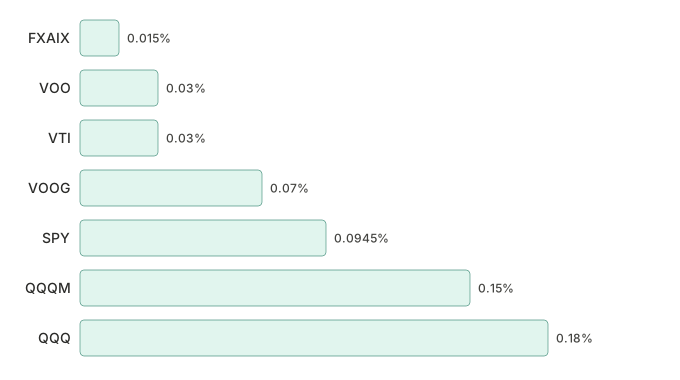
VOO (Vanguard’s S&P 500 ETF) charges 0.03% per year. That’s $3 a year per $10,000 invested. The catch is what’s inside.
As of February 2026, the top 10 holdings make up roughly 36% of the fund. Nvidia alone is about 7.3%. The Magnificent 7 (Nvidia, Apple, Microsoft, Amazon, Alphabet, Meta, Tesla) together account for roughly 30% of every dollar.
When you buy VOO, you’re not buying “the market.” You’re buying a market-cap-weighted bet that today is roughly one-third tech.
That’s not necessarily bad. It’s just the part nobody mentions when they say “buy VOO and chill.”
VTI vs VOO: the 15% nobody tells you about
VTI (Vanguard Total Stock Market ETF) holds about 3,500 US stocks instead of 500. Same 0.03% expense ratio. Same top 10. Roughly 85% of the two funds is identical, which is why their 10-year returns sit within half a percent of each other (about 14.95% per year for VOO versus 14.45% for VTI, per Vanguard).
The real difference is the bottom 15% of VTI: mid-caps and small-caps that don’t make the S&P 500.
So why pick VTI? Because over multi-decade horizons, smaller companies have historically outperformed large-caps, and VTI captures that automatically without you having to buy a separate small-cap fund.
Pick VTI if you want one fund that owns the whole US market. Pick VOO if you’ll add small-caps separately or just want to track the S&P 500 benchmark.
Holding both is mostly redundant. VOO is already inside VTI.
VOO vs SPY: identical fund, triple the cost
SPY (SPDR S&P 500 ETF Trust, the original ETF, launched 1993) and VOO own the same 500 stocks in the same proportions. Returns track to the third decimal.
The difference is the fee. SPY charges 0.0945%. VOO charges 0.03%, roughly a third of the cost. On a $100,000 position held 30 years, that gap compounds into thousands of dollars in foregone returns.
VOO overtook SPY in early 2025 to become the world’s largest ETF. Long-term holders voted with their dollars.
SPY still wins one thing: liquidity. As of March 2026, SPY’s average daily volume was about 81 million shares versus VOO’s 10 million. If you’re an options trader or moving institutional blocks, SPY is the better tool. For everyone buying their Roth IRA, VOO is the answer.
FXAIX vs VOO: half the price at Fidelity
This one’s about your brokerage.
FXAIX (Fidelity 500 Index Fund, a mutual fund priced once at end of day) tracks the same S&P 500 as VOO. Its expense ratio is 0.015%, literally half VOO’s 0.03%. Same index. Lower cost.
Think of it like a Costco store-brand: same product as the name brand, slightly cheaper, but only available at one store.
The Fidelity-only catch matters. You can’t buy FXAIX at Schwab or Robinhood. And like all mutual funds, FXAIX occasionally distributes capital gains, which can create a small tax bill in a regular taxable account.
Fidelity account, retirement account (IRA or 401k): FXAIX wins. Any other broker, or a taxable account where ETF tax efficiency matters: VOO wins.
The fee difference is real but tiny, about $1.50 per year per $10,000. The bigger factor is your platform.
VOO vs VOOG: the growth tilt is already inside VOO
VOOG (Vanguard S&P 500 Growth ETF) is half of VOO. It holds about 217 stocks, the growth half of the S&P 500, screened by sales growth, earnings change, and price momentum. Tech is roughly 44% of VOOG versus 33% in VOO.
Over 10 years, VOOG returned about 17.4% per year versus VOO’s 15%. That’s the bull case.
What gets buried: VOO already owns every stock in VOOG, weighted by market cap. The Mag 7 inside VOO is your growth tilt. Adding VOOG on top is doubling down on the same companies you already own, at 0.07% instead of 0.03%, with deeper drawdowns when growth corrects.
If you genuinely want a growth tilt, a more honest move is VOO plus a small-cap value fund, not VOO plus VOOG.
QQQ vs VOO (and the QQQM swap)
QQQ (Invesco QQQ Trust, tracks the Nasdaq-100, 100 mostly-tech stocks) returned about 20.3% per year over the past decade versus VOO’s 15%. That extra 5% per year is the entire reason the “replace VOO with QQQ” idea exists.
QQQM is the same index, cheaper. 0.15% versus QQQ’s 0.18%. If you’re choosing between them as a long-term hold, QQQM wins. QQQ stays popular only because it has deeper options liquidity for traders.
What every QQQ-vs-VOO post glosses over: in 2000, QQQ dropped 81% and didn’t fully recover until 2014. Fourteen years to break even.
Will the next decade look like the last one? I don’t know, and neither does the YouTuber telling you to swap VOO for QQQM. The Bogleheads forum keeps coming back to one Jack Bogle line: “Time is your friend; impulse is your enemy.”
QQQ or QQQM as a satellite (10 to 20% of your stock allocation): defensible. As a full VOO replacement: only if you can hold through a 50% drawdown without flinching.
Does VOO pay dividends?
Yes. VOO has paid a quarterly dividend every quarter since launch in September 2010.
The Q1 2026 payout was $1.87 per share, ex-dividend date March 27, 2026. Across all of 2025, VOO paid $7.07 per share. That’s a trailing yield of roughly 1.10% at recent prices. Small but not zero.
What matters more than the headline yield is the trajectory. Annual VOO distributions rose from $4.14 per share in 2016 to $7.07 in 2025, a compounded growth rate of roughly 6% per year. The dividend is doing real work in the background.
If you want serious yield, VOO isn’t the tool. SCHD pays around 3.4%, and dividend-focused ETFs exist for that job. VOO is for total return: price growth plus a modest, growing dividend.
Here’s what I’d actually do
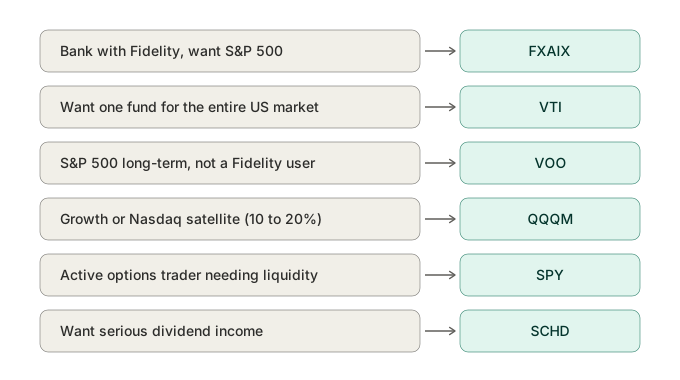
Pick one S&P 500 fund and stop tab-hopping between comparisons. Match it to your brokerage first, your strategy second. Buy it monthly, ignore everything else for a decade.
That’s the play.
The reason VOO won isn’t that it’s the smartest fund. It’s that it’s cheap enough, broad enough, and boring enough to keep buying through every panic for 30 years.
You can do that with VTI, FXAIX, or QQQM too. The fund that wins is the one you actually hold.
The cheap fund you keep buying beats the perfect fund you sell at the bottom.
FAQ
Should I hold both VOO and VTI?
Mostly no. VOO is already inside VTI, so holding both just overweights large-caps. Pick one as your core. If you want a small-cap tilt on top of VOO, a dedicated small-cap value fund gives you cleaner control than buying VTI alongside VOO.
Is FXAIX better than VOO if I have Fidelity?
For long-term, buy-and-hold investing inside Fidelity, yes. The 0.015% expense ratio (versus VOO’s 0.03%) and zero trading friction make FXAIX the slightly cheaper option. In a taxable account, VOO’s ETF structure has a small tax-efficiency edge worth considering.
When does VOO pay dividends?
Quarterly. In 2025, VOO paid $7.07 per share total, with the Q1 2026 distribution at $1.87. Current yield is roughly 1.10%. Ex-dividend dates land in late March, June, September, and December.
Can QQQM really replace VOO?
It can, but it’s a different bet. QQQM tracks the Nasdaq-100, which is heavier on tech and historically more volatile. The 2000-era Nasdaq fall took 14 years to recover. Most investors hold QQQM as a 10-20% satellite alongside VOO, not as a full replacement.
Why is VOO bigger than SPY now?
Lower fees. SPY charges 0.0945% versus VOO’s 0.03%. Long-term holders moved their money over the years to capture the difference. VOO crossed SPY in early 2025 to become the largest ETF in the world.
What’s the difference between VOO and VOOG?
VOOG holds only the growth half of the S&P 500 (about 217 stocks), tilted heavily toward tech. Higher historical returns, deeper drawdowns, and a 0.07% expense ratio versus VOO’s 0.03%. VOO already owns every stock in VOOG.
Written by thewealthora editorial team. Last updated April 30, 2026. Sources: Vanguard fund factsheets (VOO, VTI, VOOG), Fidelity (FXAIX), Invesco (QQQ, QQQM), Stockanalysis.com, Bogleheads.org, Morningstar. This post is for general information only and is not investment advice. Always do your own research or speak with a licensed advisor before making investment decisions.

Arpit Soni
Founder and Editor in Chief
Thewealthora was started to do one thing: take the money questions people actually ask and answer them in plain English, with the arithmetic shown and the catch stated rather than buried.