

On April 29, 2025, someone on r/RemoteJobs posted a question 400+ people before them had asked in some form: “Best legitimate part time remote jobs with no experience (work from home only)?” The top reply said what most articles on this topic are too polite to say: “The only way to get a legitimate remote job is to have experience.”
That reply is half right and half missing the point.
Most part-time remote job lists are the easy half — the Reddit thread underneath is where the truth lives. The winning move isn’t picking from 15 roles. It’s picking one role, building one piece of proof this weekend, and applying narrowly instead of firing 50 generic applications into the void.
- Only 9% of entry-level US job postings were fully remote in Q4 2025 vs 13% for senior roles — the market is real but tilted against beginners
- Four roles actually hire beginners at pay that’s worth the hours: customer service ($15–22/hr), virtual assistant ($18–30/hr), transcription ($15–25/hr), freelance writing ($25–50/hr)
- At 15 hours a week, even a $20/hr role clears roughly $1,200 a month gross — meaningful money if you treat it as a specific category of income, not a miracle
- The difference between getting interviews and getting ghosted is almost never the platform — it’s whether you applied with proof or with a resume
Why most “best part-time remote jobs” lists miss the point
Every guide lists the same 15 roles (VA, customer service, data entry, transcription, writing, tutoring, social media, bookkeeping, and seven more). That list is fine. It’s also useless, because applying to all of them is how people end up sending 40 applications and getting zero interviews. The market is genuinely good — 22.5% of US employees work remotely at least partially, and roughly 22% of EU workers did some remote work in 2023. But remote-capable roles are where every laid-off worker with five years of experience is also applying. Generic loses to specific, every time.
The four roles that actually hire beginners (with real pay)
Before the pay ranges and links, the honest first question is: which one fits you? Apply to all four and none of your applications will be sharp. Pick one with intent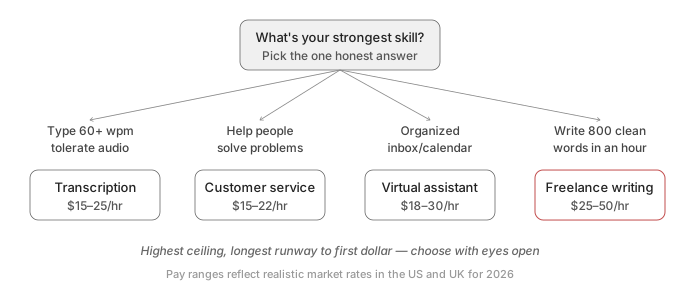
1. Remote customer service representative — $15–22/hr
The most common first remote job, full stop. Arise, TTEC, Working Solutions, and mid-size SaaS (software-as-a-service — subscription software like Slack) firms hire part-time agents for chat, email, or phone support. Evening and weekend shifts are easiest to land because fewer people apply to them. Most are W-2 roles with fixed schedules. Check We Work Remotely and direct company career pages.
2. Virtual assistant — $18–30/hr
Virtual assistants (VAs) handle email triage, scheduling, travel booking, light bookkeeping, and data work for executives and small business owners. Clients typically want 10–20 hours a week — the sweet spot for part time remote jobs that pay above minimum. The fastest route in is an agency, not Upwork: Belay, Boldly, and Time etc screen clients for you and pay more consistently. Basic admin pays $18/hr; specialists who know Notion, HubSpot, or QuickBooks push $30/hr within a year.
3. Transcriptionist — $15–25/hr effective
Turning audio into text. Lowest-barrier category, and the one where the pay headline is most misleading. Rev and TranscribeMe pay per audio minute, not per hour — a beginner earns $12–15/hr effective, a fast typist clears $20–25/hr. You take a typing test, pass, and start the same day. Medical and legal transcription pays more but needs certification.
4. Freelance writer — $25–50/hr (once you’ve landed a first client)
Highest ceiling on this list, longest runway to the first dollar. Entry-level blog writing starts at $25–35/hr; finance, healthcare, or B2B SaaS specialists clear $50–75/hr with samples. The catch everyone skips: your first paid article takes 2–6 weeks of pitching. Your second takes days. The gap between zero and one is the hardest part, which is why most people quit on week three.
What you’ll really earn — the monthly math
Pay quoted as “$20 an hour” sounds fine until you work out the monthly number. Here’s what each role actually delivers at 10, 15, and 20 hours a week, before tax.
| Hours/week | Customer service ($18/hr) | Virtual assistant ($22/hr) | Transcription ($17/hr) | Freelance writing ($40/hr) |
|---|---|---|---|---|
| 10 hrs | $780 | $953 | $737 | $1,733 |
| 15 hrs | $1,170 | $1,430 | $1,105 | $2,600 |
| 20 hrs | $1,560 | $1,907 | $1,473 | $3,467 |
Monthly gross at 4.33 weeks/month. Freelance writing assumes billable hours only; add 20–30% unpaid admin and pitching time in the first year.
At 15 hours a week in a $22/hr VA role, you clear about $1,430 a month before tax. Not life-changing alone — but invested in a Roth IRA (US tax-free retirement account, $7,500 annual limit for 2026) or an ISA (UK tax-free savings account, £20,000 annual limit), that’s meaningful wealth over a decade. The trap is treating this as extra spending cash. Part-time remote income works best with a specific job: paying down a credit card, funding an emergency account, or buying time to quit a worse full-time role.
The weekend playbook that actually gets replies
Applying to 50 generic listings is like sending the same text to 50 dating-app matches. The volume doesn’t fix the real problem — none of them can tell why you specifically are writing to them.
Here’s what works instead. It takes a weekend.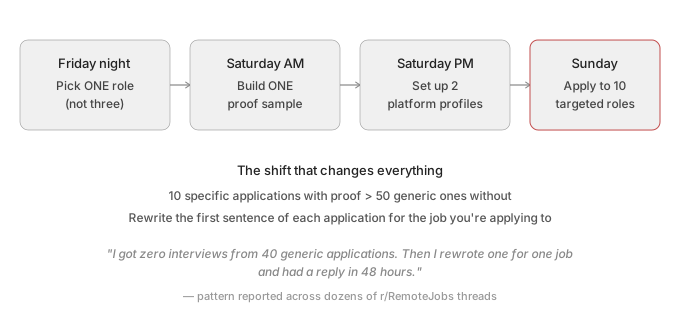
Friday night: pick one role. Type 60+ wpm and don’t mind audio? Transcription. Like talking people through problems? Customer service. Organized and email-confident? VA. Produce 800 clean words in an hour? Writing. Pick the fit, not the highest pay.
Saturday morning: build one piece of proof. A VA builds a Notion “About me” page with five tools they know. A writer writes two 600-word samples in a specific niche — not “general content,” but “fintech explainers” or “solo founder newsletters.” A transcriptionist takes the Rev test. This is the step most people skip, which is why most people get ghosted.
Saturday afternoon: set up profiles on two platforms. Not five. Two. For a VA: Belay or Boldly plus a specific LinkedIn headline. For a writer: Upwork plus a personal Notion portfolio. For customer service: FlexJobs plus three direct company applications.
Sunday: apply to 10 specific listings. Rewrite the first sentence of every application to reference something from the job post. That single change is what separates “50 generic applications, zero replies” from “10 targeted applications, two interviews.” I’ve watched people (myself included, first time around) fire off dozens of copy-paste applications for weeks, then complain the market is broken. The market isn’t broken. The applications are.
Questions people ask about part-time remote jobs
Can I do this from the UK or EU? Yes, with caveats. Many US roles restrict to US residents for payroll reasons. UK and EU options are strongest in VA work (Belay, Time etc), freelance writing (Upwork, Contra, direct pitches), and transcription (TranscribeMe takes most countries). UK freelancers register as self-employed with HMRC; EU rules vary by country.
Are any of these scams? Listings offering $40/hr for no-experience data entry almost always are. If a company contacts you first via WhatsApp, asks for upfront payment for training or equipment, or interviews you entirely by text — walk away.
How long until I see money? Customer service and VA agency roles: 2–6 weeks from application to first paycheck. Transcription: same-day to 2 weeks. Freelance writing: 4–12 weeks to a first paying client.
The Reddit commenter who said “you need experience” was right that the entry-level remote market is crowded. What they missed is that proof beats experience. A weekend of specific work gets you past the filter that a decade of generic applications never will.
Leave a Reply