What Is a Good Credit Score to Buy a Car? A Straight Answer for US and UK Buyers in 2026

A buyer with a 781 credit score and a buyer with a 540 walk into the same used-car dealership next week. Same car, a $25,000 sedan on a five-year loan, nothing down. The 781 buyer drives home paying about $5,200 in total interest over the life of the loan. The 540 buyer pays closer to $16,200. Same car, same lender, same paperwork, an $11,000 gap, paid one monthly bill at a time, because of three digits on a credit file.
Here’s the uncomfortable bit most guides won’t say out loud: the score your credit app shows you is almost never the score your car lender actually sees, and the gap between those two numbers is why a lot of buyers overpay by thousands.
Key takeaways
- US: 661+ (VantageScore) or 670+ (FICO) unlocks “prime” pricing
- UK (Experian scale): 881+ is Good; 961+ is Excellent
- The average new-car buyer in the US has a 753; the used-car buyer has 689 (Experian Q4 2025)
- Your free-app FICO and the FICO Auto Score 8 your dealer pulls can differ by 10-40 points
- A 240-point score spread on a $25,000 used-car loan = ~$11,000 in extra interest over 5 years
The minimum credit score needed to buy a car (and why it’s a floor, not a ceiling)
Roughly 69% of financed cars in the US go to borrowers with scores above 661, per Experian’s Q4 2025 automotive finance report. That’s the widely accepted “prime” line, in a good credit score to buy a car conversation, it’s the point where your offer stops being whatever the lender will do and starts being something competitive.
But “minimum” is a trap. Sub-600 borrowers still get approved every day, about 15% of financed cars go to buyers under 600. The question isn’t whether you can get approved. It’s whether you want the loan they’ll offer you.
A daily-life analogy helps. Credit score bands are like airline boarding groups. The gate agent doesn’t care whether you have 42,000 miles or 98,000, you board Group 2 either way. Lenders do the same. Your 695 and someone else’s 725 both land in “prime” and get a nearly identical offer. The band matters; the exact number rarely does.
The scoreboard problem, why your FICO Auto Score isn’t the number on your app
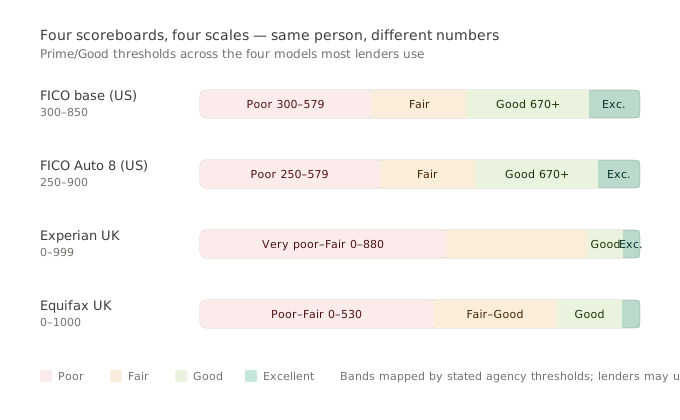
Most free credit apps, Credit Karma, your bank dashboard, the Experian free tier, show you a base FICO Score or VantageScore that runs 300 to 850.
Most car lenders don’t use that one.
They use the FICO Auto Score 8 (or 9, or 10), an industry-specific version that runs 250 to 900 and weighs past auto-loan behaviour more heavily than a random credit-card slip. “FICO Auto Scores are tailored to focus on auto loan risk,” per Experian’s own guidance. So a base FICO of 712 can come back as a 694 Auto Score, or a 728. You don’t know until the dealer pulls it.
Full disclosure: when I walked a friend through this last year, his base FICO read 721 on the Experian app the morning of the appointment. The credit union pulled his Auto Score 8. It came back 694. Same person, same debts, same day, different scale, different starting point. His offer didn’t change, but the conversation did.
Side-by-side comparison of FICO base, FICO Auto Score 8, Experian UK, and Equifax UK credit score bands
Ask the lender which model they pull before you sign. Most will tell you if you ask directly.
What each score band actually costs, the credit score for car loan ladder
Here’s where the credit score for car loan conversation gets concrete. Experian Q4 2024 data, VantageScore 4.0, used-car APR:
Horizontal bar chart showing average used-car APRs by credit tier, from 7.67% for super prime to 21.81% for deep subprime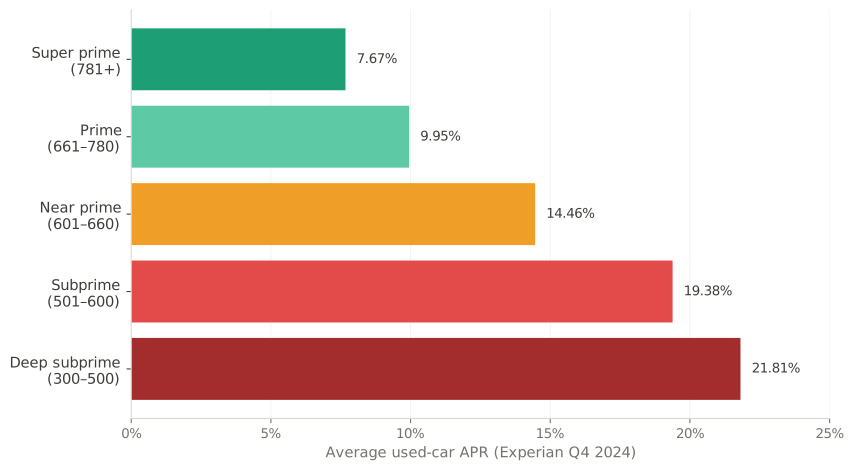
On a $25,000, 60-month used-car loan with nothing down, that translates into real dollars:
| Credit tier | Used-car APR | Total interest paid |
|---|---|---|
| Super prime (781-850) | 7.67% | ~$5,200 |
| Prime (661-780) | 9.95% | ~$6,835 |
| Near prime (601-660) | 14.46% | ~$10,251 |
| Subprime (501-600) | 19.38% | ~$14,167 |
| Deep subprime (300-500) | 21.81% | ~$16,186 |
“Most borrowers need a FICO score of at least 661 for a competitive rate,” per Bankrate. The ladder shows why. Moving from near-prime to prime, a 60-point jump from, say, 640 to 700, saves you about $3,400 on that loan. Not a 2% difference. A used-car-payment-sized chunk of your next year’s salary.
Bar chart showing total interest paid on a 25,000 dollar 60-month used car loan across five credit tiers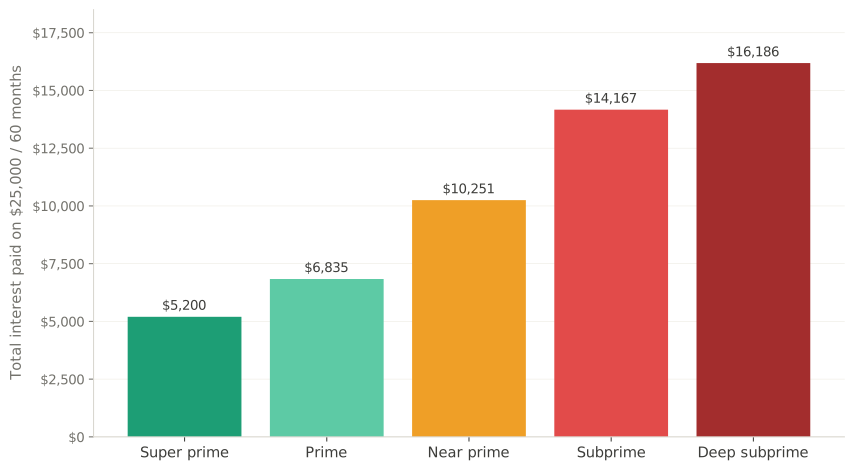
Red flag to watch for. Deep-subprime buyers are the group that US “buy-here-pay-here” dealers and UK specialist lenders target hardest, advertised rates run 22-29%. If a dealer hands you a contract without first pre-approving you with a bank or credit union for comparison, walk out. A 15-minute detour can save five figures.
The UK angle, three agencies, three different scales, one headache
If you’re in the UK, your “credit score” is actually three credit scores. Experian, Equifax, and TransUnion each score you on their own scale, and no two lenders consistently use the same one.
Rough equivalents for good credit for car finance:
- Experian (0-999): 881+ Good, 961+ Excellent
- Equifax (0-1000): 531+ Good, 811+ Excellent
- TransUnion (0-710): 604+ Good, 628+ Excellent
UK car finance APRs in April 2026 are running roughly 7-11% on new cars and 9-14% on used, per FCA and industry data. A good credit score pulls your PCP (Personal Contract Purchase, the lease-to-own structure that covers 60-70% of all UK new-car finance) or HP (Hire Purchase, where you own the car outright at the end) offer toward the bottom of that range. “Representative APR means the rate offered to at least 51% of applicants,” per FCA guidance. In plain English: the headline rate in the advert is a marketing number, not a promise. Yours can be higher.
One thing the UK rewards that the US doesn’t as strongly: a personal loan for the car purchase often beats dealer finance by 2-4 percentage points. A 6.9% personal loan on a £20,000 car beats a 10.9% PCP by roughly £1,800 over three years. Boring, but real.
Can you buy a car with a 600 credit score?
Yes. You can get a car loan with a 500. What you can’t get is a competitive rate.
A 600 US FICO puts you in near-prime territory, expect 12-15% APR on a used car, against 7-8% for someone at 740. On a $20,000 loan over 60 months, that’s about a $4,500 gap. Worth waiting six months for a 50-point jump, if you can afford to wait. Not everyone can, and that’s fine, but it’s worth asking the question before you sign.
If your score isn’t there yet, what moves the needle in 60-90 days
Two things move scores fast. The rest is noise.
1.Pay credit card balances under 30% of each card’s limit. Credit utilisation is roughly a third of your score and updates the fastest, usually within one billing cycle. Highest-ROI move there is. If you do only one thing before applying, do this.
2. Dispute genuine errors on your credit report. All three US bureaus and all three UK agencies have free dispute processes. One fraudulent late payment or an old closed account reporting as open can drag your score 20-40 points for no reason you’ve earned.
Things that don’t move the needle as fast as people think: paying off a collection account (the damage is often already baked in), closing unused credit cards (can actively hurt by raising utilisation), or becoming an authorised user on a parent’s card (helps, but slowly).
One last thing
The good credit score to buy a car isn’t a single magic number. It’s a band, and the band you’re in next Tuesday is the one that decides whether you pay $5,000 or $14,000 in interest on the same car. Check your score tonight, pull it again in a month, and don’t sign anything you haven’t pre-approved somewhere else first.

Arpit Soni
Founder and Editor in Chief
Thewealthora was started to do one thing: take the money questions people actually ask and answer them in plain English, with the arithmetic shown and the catch stated rather than buried.