Crypto Regulation News: What Actually Changed in 40 Days (And What to Do Now)
 Arpit Soni
· Updated · 6 min read
Arpit Soni
· Updated · 6 min read 
On March 17, 2026, two US agencies that spent the last ten years fighting over crypto did something nobody expected. They issued a single 68-page document, and most crypto stopped being a “security” overnight.
Between then and April 22, four big things landed in just 36 days. An SEC and CFTC joint statement that finally answered “is Bitcoin a security.” Three proposed stablecoin rules from the FDIC, Treasury, and FinCEN. And a hard EU deadline now just 65 days away.
Most coverage mashes all of it together. Half of it is already binding, and the other half is still a proposal you can safely ignore until summer.
Sorting which is which takes ten minutes. Here’s the sorted version, written for someone who actually holds crypto on an exchange, not for a compliance officer.
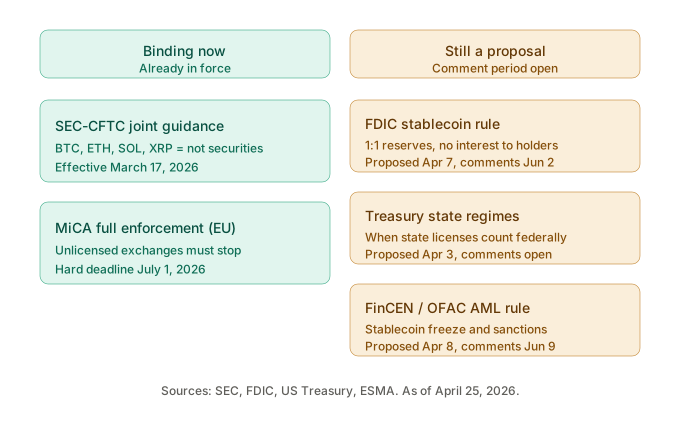
Comparison diagram showing binding crypto regulation (SEC-CFTC guidance, MiCA enforcement) vs proposed rules under the GENIUS Act in April 2026
What actually changed on March 17 (almost nobody noticed)
If you hold Bitcoin, Ether, Solana, or XRP on a US exchange, March 17 was a quietly huge day. Almost no one outside crypto law firms picked up on it.
The SEC (Securities and Exchange Commission, the US agency that decides what counts as a “stock”) and the CFTC (same idea, but for things like oil and wheat) issued a joint document putting every major crypto asset into one of five buckets.
Four of those buckets are not securities under federal law. The practical effect is huge: the SEC can no longer keep suing exchanges for listing these tokens, the way it did with Coinbase and Kraken for years.
Until March 17, the SEC used a 1946 Supreme Court case called the Howey test (the legal yardstick for “is this a security?”) to make that call. Gary Gensler’s SEC applied it aggressively. Paul Atkins’s SEC has now pulled most of crypto out of that net, and the CFTC signed onto the same approach.
CFTC Chairman Michael Selig called the move “a shared commitment to developing workable, harmonized regulations.” Coinbase’s top lawyer Paul Grewal was less diplomatic: “The healing continues.”
The five buckets break down like this. Digital commodities (Bitcoin, Ether, Solana, XRP, Chainlink, plus a dozen more), digital collectibles (most NFTs), digital tools (utility tokens), and stablecoins are all out of SEC reach. Only digital securities , meaning tokenized stocks and bonds, stay regulated as securities.
For a regular holder, the legal fog around your main coins just lifted. Exchanges are far less likely to suddenly delist them, and new products like staking services, spot ETFs, and crypto-backed loans should launch faster in the US over the next twelve months.
This part is already binding. No comment period. No final vote. Done.
The three April proposals you can mostly ignore (for now)
Between April 3 and April 8, three US agencies dropped proposed rules under the GENIUS Act, the stablecoin law signed in July 2025. Headlines made it sound like the new regime had landed.
It hasn’t.
A proposed rule works like an email from your landlord saying “we’re thinking about changing the pet policy, comments due by June.” Until the comment period closes and the final version is published, nothing actually changes for you.
Here’s what’s on the table.
The FDIC (Federal Deposit Insurance Corporation, the agency that insures US bank deposits) wants stablecoin issuers to hold a real dollar in reserve for every dollar issued, redeem within two business days, publish monthly audits, and stop paying any interest to holders. It also proposes a 40% cap on how much any single issuer can park at one bank, forcing Circle and others to spread their billions around.
Treasury wants state licensing rules to meet federal standards. FinCEN and OFAC want anti-money-laundering rules that would force issuers to freeze flagged transactions.
Comment periods on all three close between June 2 and June 9, 2026.
Then on April 22, the American banking industry formally asked Treasury to slow it all down, arguing the proposals are inconsistent with each other. Final rules probably don’t take effect until late 2026 or early 2027.
For a retail holder with $1,000 in USDC sitting on Coinbase, nothing in your account changes this month.
But if your stablecoin pays you yield through some clever DeFi setup, that yield is almost certainly getting banned in the final rules. Honestly, I don’t know yet whether the big platforms will find a workaround, the final text hasn’t been written.
Timeline of key US and EU crypto regulation dates from March 17 to July 1, 2026, covering SEC-CFTC guidance, FDIC and FinCEN stablecoin rules, and MiCA enforcement deadline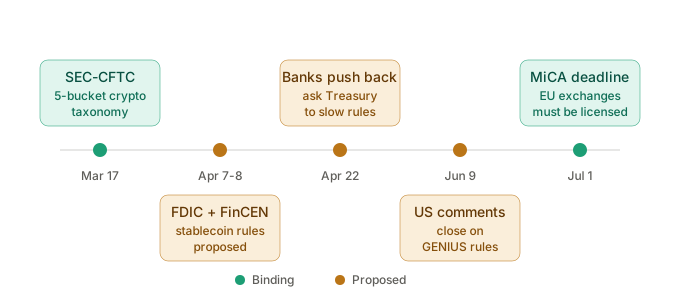
If you live in the EU, July 1 is your real deadline
Europe is moving in the opposite direction. Instead of drafting new rules, it’s about to finish enforcing existing ones.
MiCA (Markets in Crypto-Assets, the EU’s main crypto law) has been rolling out since late 2024 under a grandfathering period that let exchanges keep operating without a license while they applied for one. That period ends on July 1, 2026, now roughly 65 days away.
After that date, any crypto exchange operating in the EU without a MiCA license has to stop. Full stop.
ESMA (the EU’s main markets regulator) issued a statement on April 17 reminding national regulators across all 27 member states to enforce the cut-off. If you live in Germany, France, Spain, or Italy and you use a smaller exchange without a European office, check the ESMA interim MiCA register today. If your platform isn’t on the list, your funds could become harder to withdraw, or stuck, after July 1.
A bigger shift is also coming, but slower. At Paris Blockchain Week in mid-April, a senior European Commission adviser confirmed MiCA 2 is already being drafted, with a public consultation that will cover DeFi, NFTs, and staking. The Commission has to report by June 30, 2027, so MiCA 2 is years of debate away.
None of that affects you in 2026. But your current exchange’s license status on July 1 absolutely does.
Three things to do this week, by where you live
| Step | US | UK / EU |
|---|---|---|
| 1. Easy: Check your exchange is licensed | FinCEN MSB register | ESMA MiCA interim register |
| 2. Smart: Look at any stablecoin you hold | Stick to USDC or PYUSD; cancel any DeFi yield arrangement | Same, and confirm your platform is MiCA-registered |
| 3. Pro: Bookmark the real deadlines | June 9 (US comment period closes) | July 1 (MiCA hard cutoff) |
For most readers, Step 1 is the most important and takes three minutes. Open your exchange app, find the “About” or “Legal” page, and look for the licensing line. If it’s missing, or the license is from somewhere unfamiliar, that’s the thing to fix before anything else.
If something in the final GENIUS Act rules ends up affecting you directly, you’ll read about it between June and September of this year. Not before.
Here’s what I’d actually do
Pick the licensed exchange. Hold a regulated stablecoin. Bookmark June 9 and July 1.
That’s the whole list.
The legal earthquake of 2026 didn’t arrive in one event. It arrived as four smaller ones in 36 days, half binding, half still drafts.
Regulation isn’t happening to crypto anymore. It’s happening inside crypto.
And for the first time in a decade, you can actually tell where the line is.

Arpit Soni
The Thewealthora desk covers markets, money and personal finance, with zero jargon and every claim sourced.