The smart money concept: what banks see that you don’t


You set a clean stop loss, price spikes just past it by a few points, your trade closes at a loss, and then the market turns and runs exactly where you thought it would go. If that has happened to you, you have already met the smart money concept in the wild. You just did not have a name for it yet.
The smart money concept is the idea that big institutions move price on purpose, sweeping the spots where small traders park their orders before the real move begins. (smart money here just means banks, hedge funds, and market makers, the players with the most capital.) Learn to read their footprints, the theory goes, and you stop being the one who gets shaken out.
The smart money concept is a genuinely useful way to read a chart, but most of it is decades-old theory wearing new clothes, and the data on people who trade it is brutal. This post teaches the concept properly, then tells you the half the YouTube tutorials leave out.
What the smart money concept actually means (and who invented it)
At its core, the smart money concept says markets do not move randomly. They move toward liquidity, which is just a fancy word for clusters of resting orders. (liquidity is simply where lots of buy or sell orders sit waiting, usually right above obvious highs and below obvious lows.)
Big institutions have a problem you do not have. They cannot buy or sell in one click, because their orders are so large they would move the price against themselves instantly. So they accumulate quietly, push price into the zones where everyone else is forced to react, and use that flood of orders to fill their own. The smart money concept is the attempt to spot that behaviour on a chart before it finishes.
The framework was popularised by Michael Huddleston, a US trader who goes by the alias Inner Circle Trader, or ICT. He started publishing free videos in the 2010s that organised these ideas into named patterns, and the smart money concept exploded across forex and crypto communities from there. Worth knowing, though: as I covered in my crypto trading for beginners walkthrough, popularity and profitability are not the same thing.
The uncomfortable truth nobody on YouTube mentions
Here is the part the course sellers skip. The smart money concept did not appear from nowhere, and Huddleston did not invent its building blocks. Most of them trace straight back to Richard Wyckoff, a trader writing in the early 1900s.
What ICT calls smart money, Wyckoff called the Composite Operator. What modern traders call a stop hunt, Wyckoff described as springs and upthrusts a century ago. Even broker education sites that teach the smart money concept admit the three-phase logic at its heart was mapped out by Wyckoff decades earlier. One veteran trader put it bluntly when he said ICT was “trying to overwrite trading history.”
That does not make the concept worthless. But it should change how you treat anyone selling a $2,000 course on “secret” institutional knowledge. The ideas are public, old, and free.
Then there is the outcome data, which is the number every guru avoids. Regulators in Europe force brokers to publish how many of their retail customers lose money, and the figures are grim.
The honest picture looks like this.
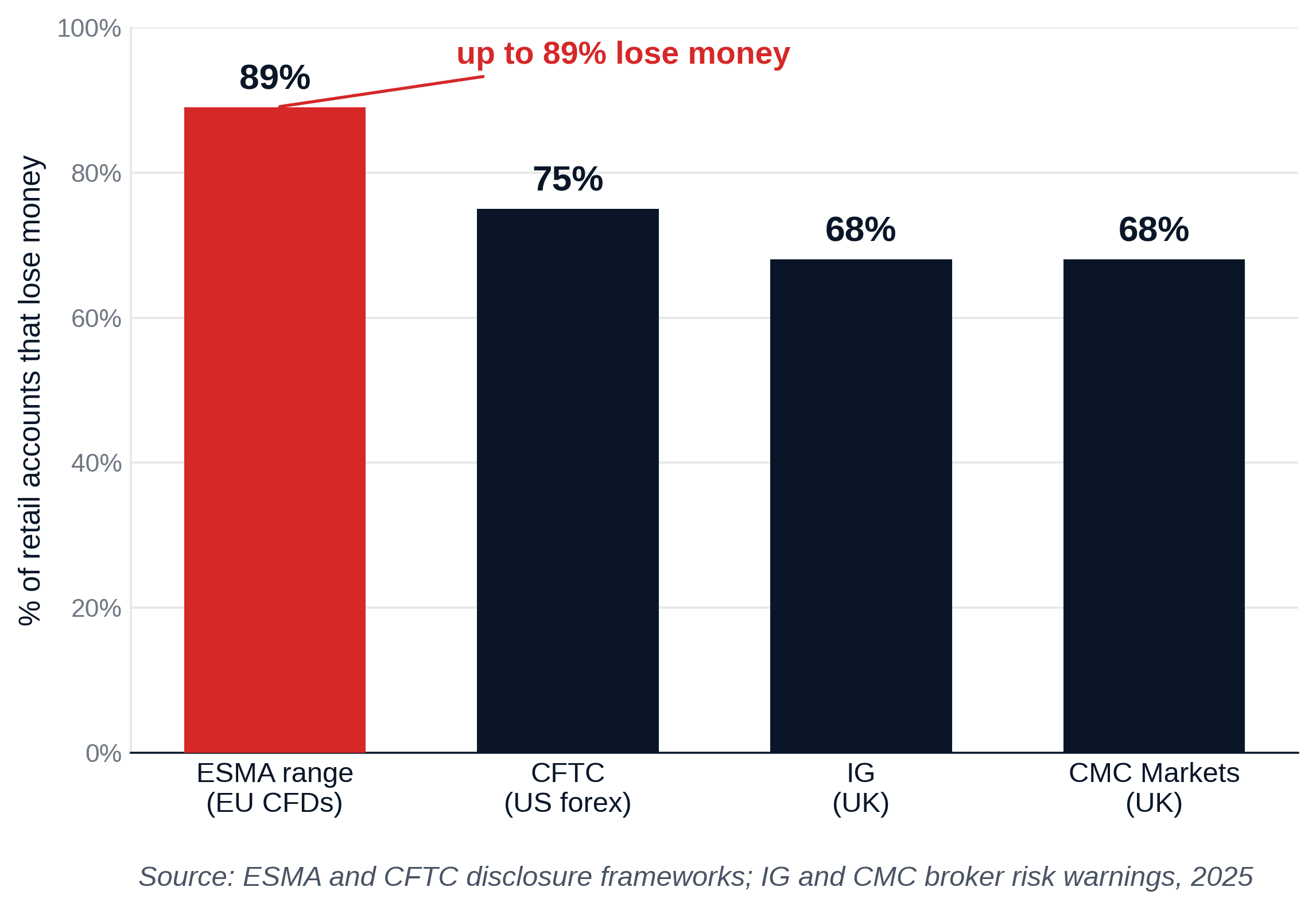
US futures regulator the CFTC reports that roughly two out of three retail forex traders lose money every quarter. Average losses in the European data run from €1,600 to €29,000 per person.
So when a video promises the smart money concept will flip you to consistent profits, hold it against that backdrop. The concept is a lens, not a money printer, and most people pointing the lens still lose.
The five building blocks of the smart money concept, in plain English
Strip away the jargon and the smart money concept rests on five ideas. Learn these and you can read 90% of what any SMC video is actually saying.
1. Market structure. This is just the trend, drawn as a series of highs and lows. An uptrend makes higher highs and higher lows. A downtrend makes lower highs and lower lows. Everything else hangs off knowing which one you are in.
2. Break of structure and change of character. A break of structure (BOS) is price continuing the trend by taking out the last high or low. A change of character (CHoCH) is the first crack in the other direction, the early hint the trend may be flipping. (think of CHoCH as the moment a winning team concedes a goal against the run of play.)
3. Liquidity. Equal highs and equal lows look like strong support or resistance to beginners, so that is exactly where they place stops. The smart money concept treats those obvious levels as targets, not walls. Price often spikes through them to trigger the stops, then reverses.
4. Order blocks. An order block is the last candle before a sharp, decisive move. The theory says institutions left unfinished business there, so price tends to return to that zone before continuing. Traders use it as a discounted entry area.
5. Fair value gaps. When price moves so fast it leaves a gap with little trading inside it, that gap is called a fair value gap (FVG) or imbalance. Price statistically revisits these fair value gaps to rebalance roughly 70% of the time, which makes them handy pullback targets.
Because the vocabulary is the real barrier, here is a plain-English decoder, including what each term was called before it got rebranded.
| SMC term | What it actually means | Older name for it |
|---|---|---|
| Smart money | Banks, funds, market makers with size | Wyckoff’s composite operator |
| Liquidity grab / stop hunt | Price spikes to trigger resting stops | Spring and upthrust |
| Order block | Last candle before a strong move | Supply and demand zone |
| Fair value gap | A price gap that often gets refilled | Imbalance / inefficiency |
| Change of character | First sign a trend may be flipping | Trend reversal signal |
None of this is magic. It is a cleaner vocabulary for support, resistance, and momentum that traders have watched for a hundred years.
How a stop hunt actually plays out on the chart
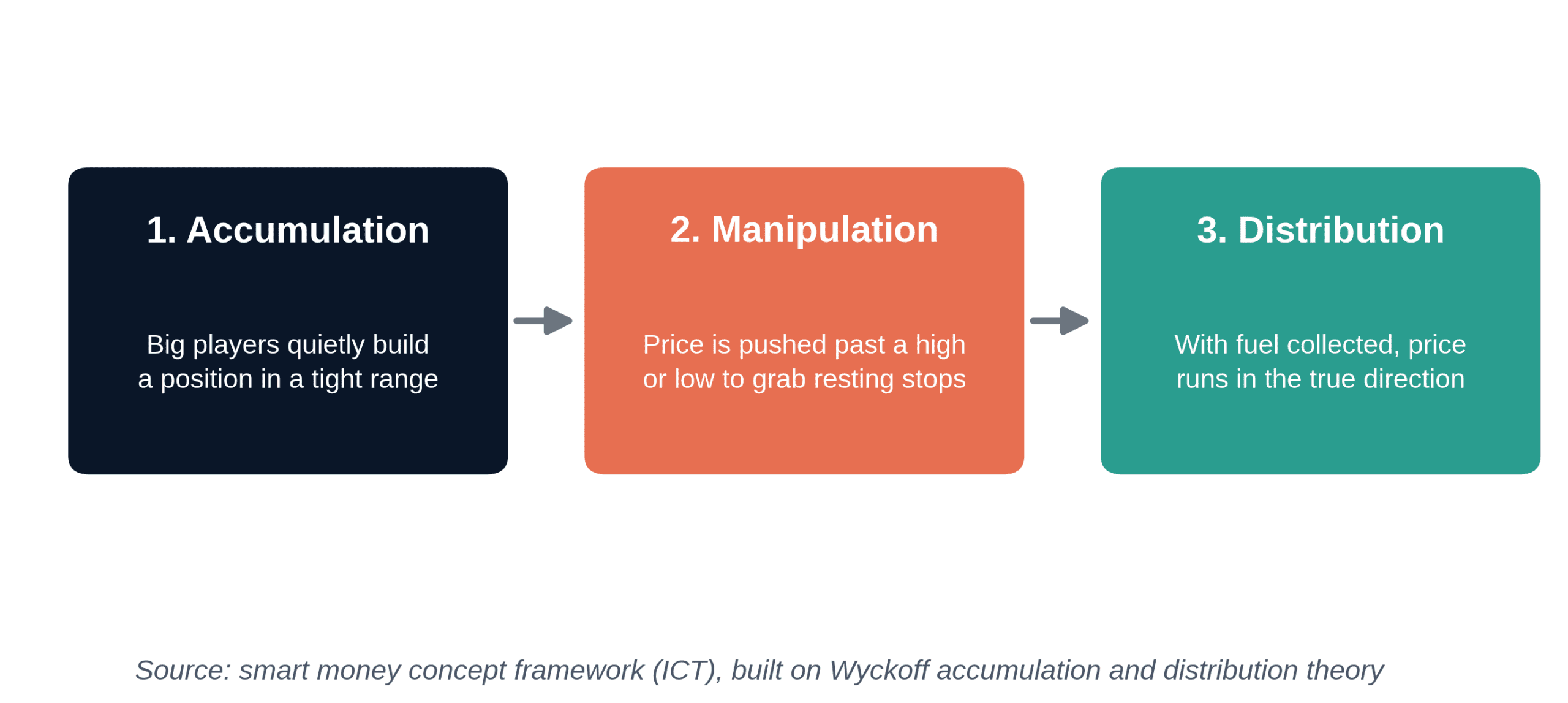
The smart money concept usually frames a move in three phases, and once you see it you cannot unsee it. Here is the cycle.
 .
.
First, accumulation: institutions quietly build a position inside a tight range, often during quiet hours, without tipping their hand. Second, manipulation: price is pushed past an obvious high or low to grab the stops resting there, the part retail traders feel as a stop hunt. Third, distribution: with enough fuel collected, price runs hard in the real direction.
Picture trying to buy ten thousand concert tickets the second they go on sale. You cannot, because your own buying spikes the price instantly. So you wait for casual fans to panic and dump their tickets cheap, scoop them up in the chaos, then watch the show sell out. That panic-dump is the stop hunt, and the sell-out is the move you wished you had caught.
Here is what a single sequence looks like when you mark it up.
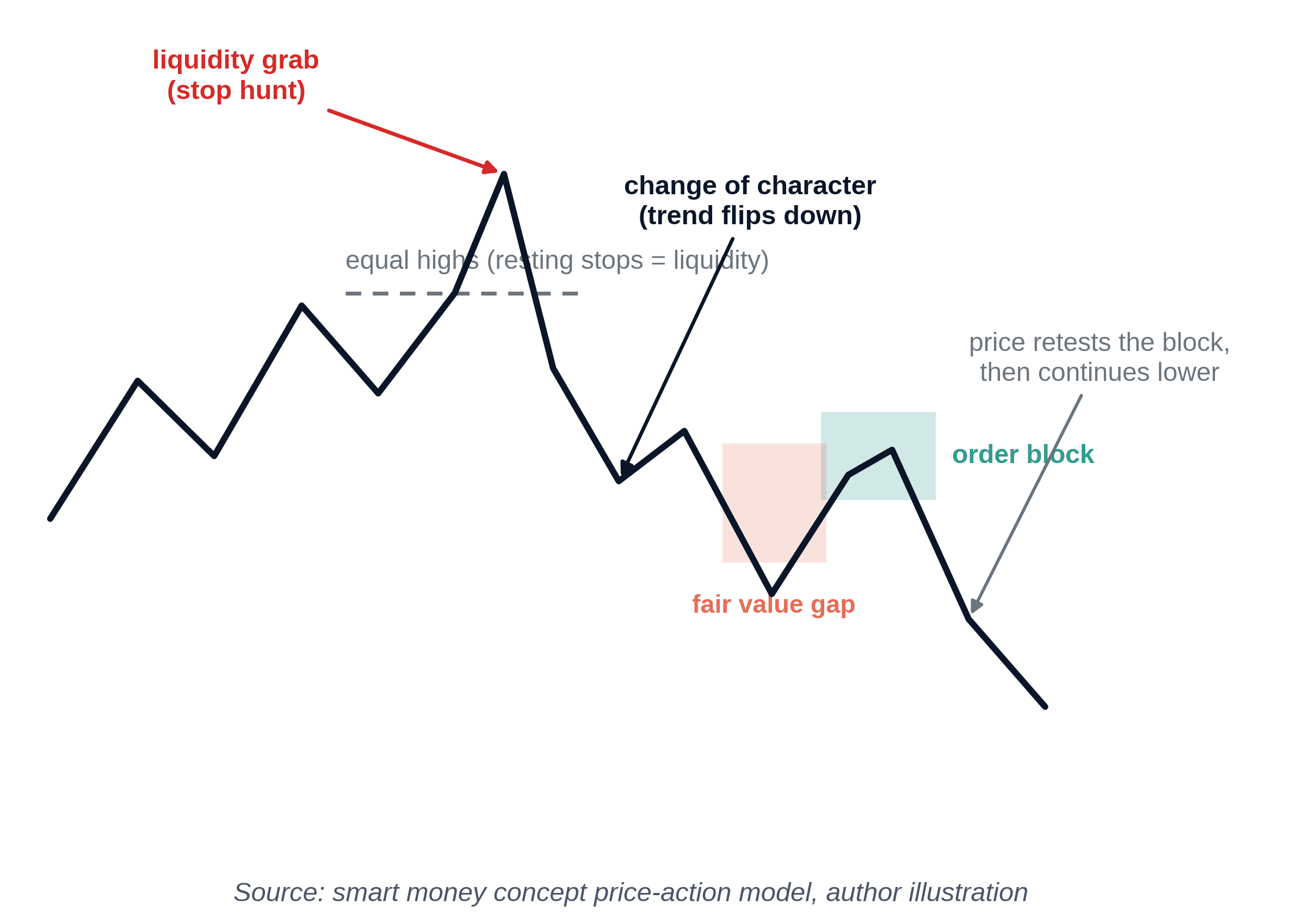
Price drifts into a zone of equal highs where stops are stacked, sweeps just above them to grab that liquidity, then snaps back down and breaks structure. It leaves a fair value gap on the way, retraces into the order block to fill remaining orders, and continues lower. Do institutions literally hunt your specific stop loss? Not personally. But they absolutely target the price levels where stops cluster, because that is where the orders they need are sitting.
For entries, many SMC traders wait for price to return to an order block or fair value gap inside a discount zone, often the 62% to 79% retracement band they call the optimal trade entry. A clean example: a bullish order block on EUR/USD at 1.0820 to 1.0835 becomes a magnet, and a trader risks 1% with a stop just below the block, targeting two to three times that risk at the next pool of liquidity.
Where the smart money concept helps and where it falls apart
Used well, the smart money concept gives you something most beginners lack: a reason price is moving, not just a lagging indicator flashing after the fact. It forces you to think in terms of structure, where orders rest, and which direction has the bigger players behind it. That mental shift alone is worth the study time.
The problem is subjectivity. The rules sound objective until you try to apply them live, and then they blur. As one trading analyst put it, “two traders examining the same chart will disagree on whether displacement occurred.” The framework has a slippery quality: when a trade works the model gets the credit, and when it fails you “misread” the setup. That structure makes it almost impossible to prove wrong, which is comforting and dangerous in equal measure.
I will be honest with you. I cannot always tell a real reversal from a fake sweep in the moment, and neither can anyone selling you a signal service. Hindsight charts look obvious because the answer is already printed. Real time is fog.
Is the smart money concept better than indicators? It is not better or worse, it is a different lens. Indicators tell you what price did; the smart money concept tries to tell you why. Is it profitable? It can be, in disciplined hands with strict risk control, but the concept itself does not carry an edge you can backtest cleanly the way you can a moving-average crossover. The edge, if there is one, lives in your execution. If you want to watch the market without a fancy terminal, I broke down the market-watching tools that actually matter separately.
Here’s what I’d actually do if you’re starting out
Learn the five building blocks until they are second nature. Backtest and demo trade them for months before risking a cent. Never put more than 1% of your account on one idea.
Respect the fog.
Treat the smart money concept as a way to read price with more context, not as a secret handed down from someone who cracked the banks. The concept is real, the structure is useful, and the discipline it forces is good for you. The promise that it makes trading easy is the costly trap, and that promise is the one thing in this whole space you can be sure is false.
If the loss numbers made you flinch, that is a healthy reaction, and it is worth asking whether active trading suits you at all. Plenty of people build more wealth doing nothing exciting, and the boring index-fund route I usually point people toward beats most active traders over a decade without the stress.
The market does not owe you a clean signal. It owes you nothing at all, and that is exactly why the people who survive it stay humble.
Most people learn the smart money concept from YouTube breakdowns. If you like saving those to study offline, GrabVex is the free multi-platform downloader I built, with dedicated tools for YouTube video downloads and Pinterest video downloads.
Sources
- ESMA, retail CFD risk disclosure framework, 74 to 89% of accounts lose money (esma.europa.eu)
- CFTC, retail forex trader outcome data (cftc.gov)
- ATAS, the smart money concept and ICT strategy explained, Wyckoff parallels (atas.net)
- Power Trading Group, ICT concepts as rebranded Wyckoff methods (powertrading.group)
- AlgoStorm, ICT SMC entry models critical guide, subjectivity and hindsight (algostorm.com)
- Equiti, the smart money concept in forex, fair value gap fill rate (equiti.com)
Keep learning: browse all our crypto and forex guides.

Arpit Soni
Founder and Editor in Chief
Thewealthora was started to do one thing: take the money questions people actually ask and answer them in plain English, with the arithmetic shown and the catch stated rather than buried.