Crypto trading for beginners: 1 simple, safe move for $100

In 2025, a survey of 1,005 people who had just finished their first year of crypto trading found that 84% of them lost money. The Bank for International Settlements, looking at exchange-app users across 95 countries, put the figure for retail Bitcoin buyers at roughly three in four.
Almost every guide on crypto trading for beginners skips that number and jumps to “open an account, here are 7 strategies.”
The single most profitable move a beginner can make in 2026 is to trade less, not more, and to start with money you can lose, like $100.
Here is the honest version, with the math, the 2026 tax rules nobody warns you about, and the one setup that actually protects you.
The 84% number nobody puts on the homepage
The pitch is always the same. Crypto runs 24/7, you can start with $10, and the charts make it look like free money is one good trade away.
The data tells a colder story. In that 2025 first-year survey, 58% of new traders lost almost everything, and day trading was named the biggest single cause of those losses. Stretch the timeline and it gets worse: industry day-trading research suggests only around 13% are still trading after three years, and roughly 7% ever reach consistent profit.
Most beginners are not losing because they picked the wrong coin. They are losing because of how often they trade and how little they planned.
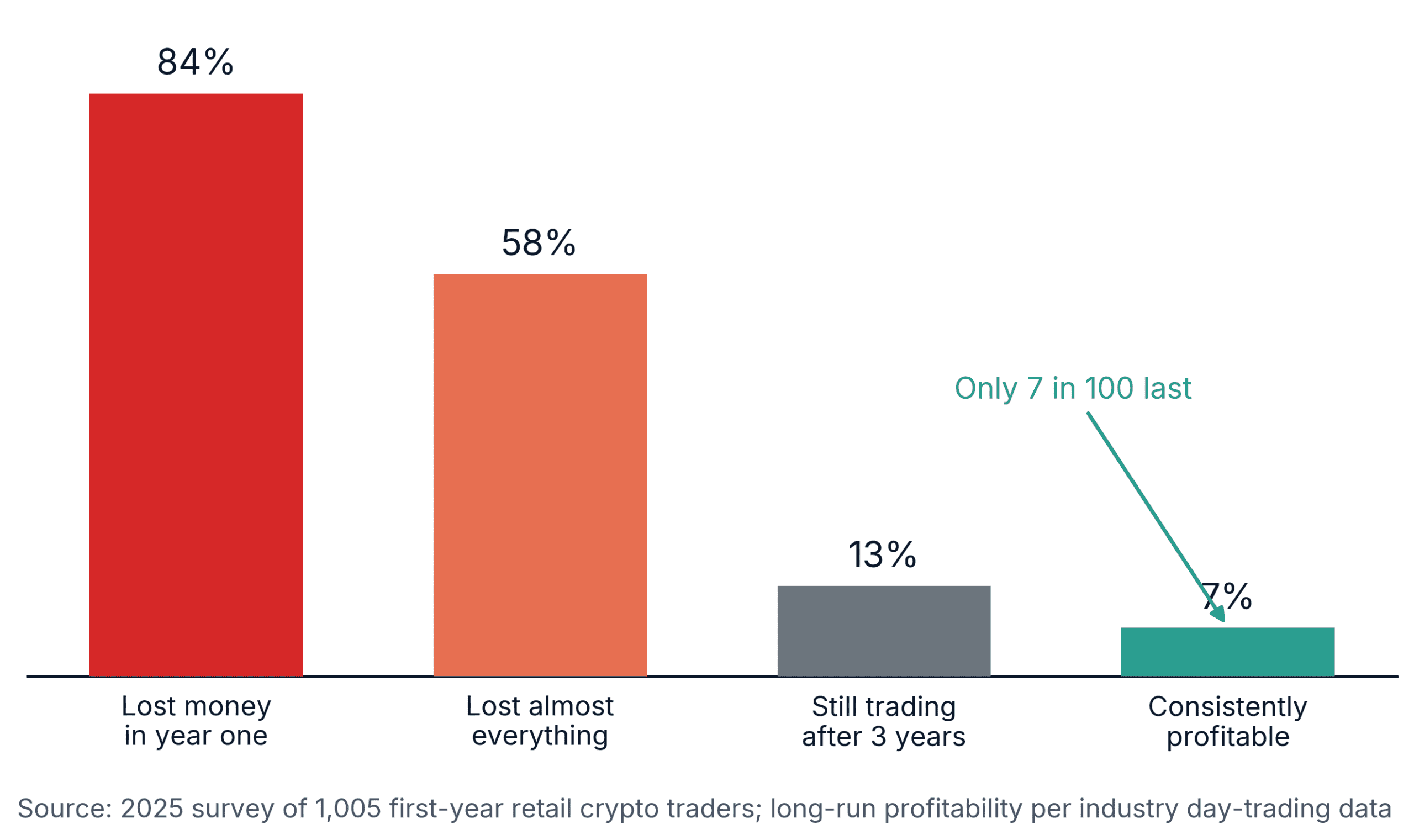
The two tall bars are losses, the two short ones are survival. That gap is the real subject of any honest guide to crypto trading for beginners.
I learned this the expensive way myself. When I ran the XRP reality check I ran, the pattern was identical: the people who got hurt were not the ones who held, they were the ones who kept jumping in and out chasing the next move.
Trading and investing are not the same sport
This is the part the listicles blur, and it costs people real money.
Investing means buying something and holding it for years, betting the whole asset class grows. Trading means buying and selling often to profit from short price moves. They use the same screen and the same coins, so beginners assume they are the same game. They are not.
Think of it like a gym membership versus a sprint. One rewards you for showing up steadily over years. The other rewards a tiny number of elite people and quietly punishes everyone who tries to go full speed on day one.
Most people typing “crypto trading for beginners” into Google actually want the investing sport. They want exposure to Bitcoin or Ethereum without losing their shirt, not a second job staring at candles. (candles are the little red and green bars on a price chart, each showing how the price moved in a set time window.)
If you cannot explain why you are selling before you buy, you are not trading. You are gambling with extra steps.
Crypto trading for beginners starts with not trading
Here is the move I would actually make with a first $100. Buy one major coin, on a regulated exchange, on the spot market, and sit on your hands.
Spot means you buy the actual coin with your own cash, no borrowing. (the opposite is leverage, where you trade with borrowed money and a small move against you wipes you out.) Spot is the boring, survivable end of the pool, and boring is exactly what the 7% who last tend to do.
The reason “do less” beats “do more” is fees. Every time you buy and sell, the exchange takes a cut, usually around 0.5% per trade on beginner platforms. That sounds tiny until you trade often.
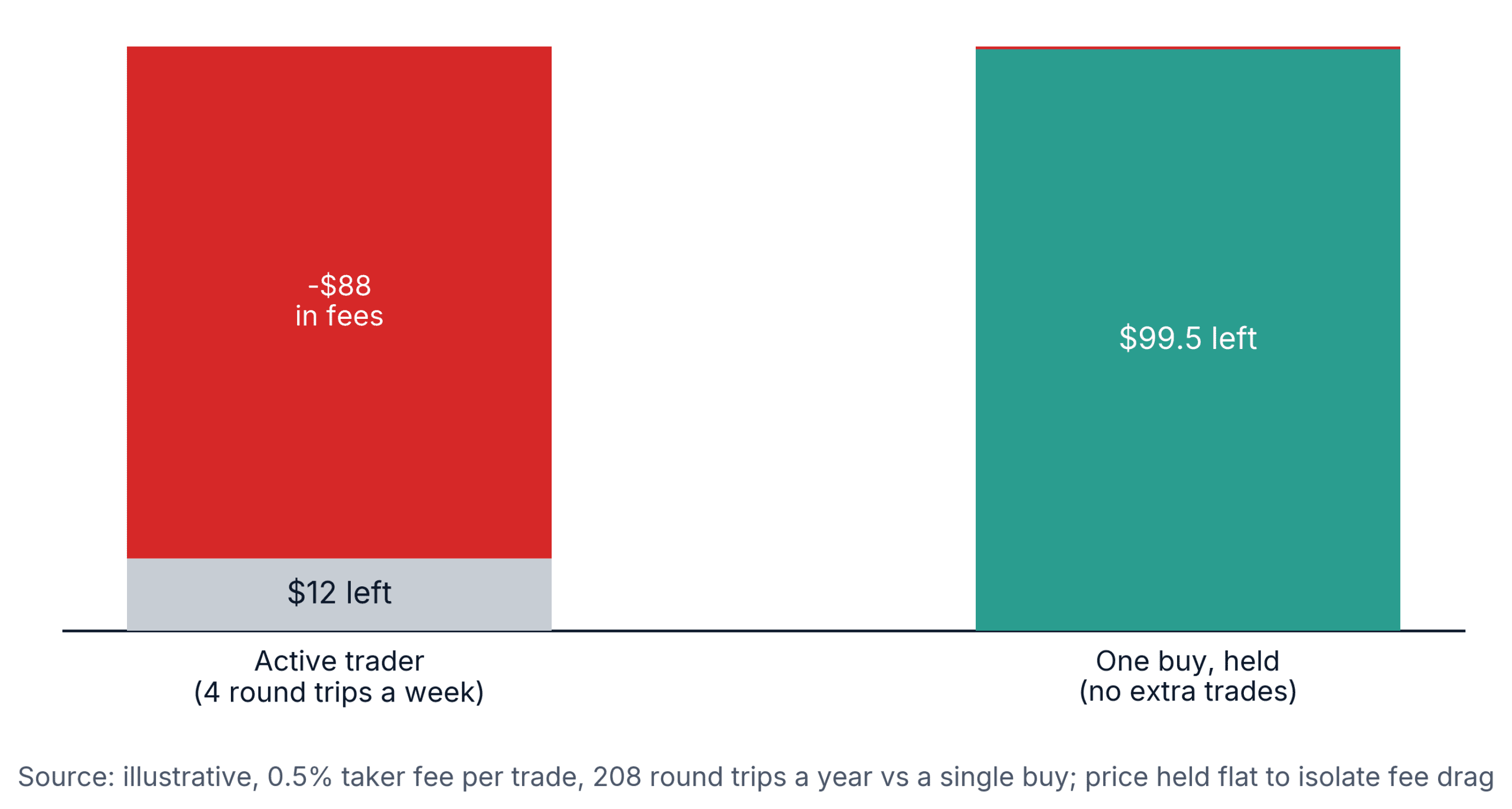
That is not a trick. Same $100, same coin, same flat price. The active trader doing four round trips a week hands almost the entire balance to the exchange in a year, while the person who bought once keeps nearly all of it. The market did not even move. Activity alone did the damage.
If you want to add money over time instead of one lump, use dollar-cost averaging. (buying a fixed amount on a fixed schedule, say $25 every Friday, so you are not betting everything on one day’s price.) I broke down the exact mechanics in a clear $25-a-week plan, and the same discipline maps onto crypto cleanly.
The 4 things to set up before your first trade
Before any money moves, get these four right. This is the part the better guides get correct, so it is worth inheriting.
1. A regulated exchange. In 2026 the common beginner picks are Coinbase, Kraken, and where available Binance. Coinbase tends to be the most beginner-friendly with strong US compliance. Pick one that legally operates where you live and finish identity verification. (KYC, or know your customer, the ID check exchanges legally must run before you can trade.)
2. A wallet plan. Coins left on an exchange are only as safe as that exchange. For small amounts, the exchange is fine to start. For anything you would hate to lose, learn about a self-custody wallet, where you hold the keys yourself.
3. Order types. Learn two before you trade. A market order buys instantly at whatever price is available. A limit order only buys at the price you set or better. Beginners who only use market orders on low-liquidity coins get hit by slippage. (slippage is paying a worse price than you expected because there were not enough sellers at your price.)
4. Fees, in writing. Find your exchange’s exact taker and maker fee before you trade, not after. A platform charging 0.1% versus one charging 0.6% is a six-fold difference on the same activity.
That is the whole setup. None of it requires predicting anything.
Where crypto trading for beginners quietly goes wrong
The mistakes are predictable, which is good news, because predictable means avoidable.
The 2025 survey found the two biggest beginner errors were poor research (55%) and FOMO (44%). (FOMO, fear of missing out, the urge to buy something purely because it is going up and you cannot stand watching.) Almost half of new traders admitted buying at or near a peak because a coin was pumping, then watching it fall.
FOMO has an evil twin: revenge trading, where you take a loss and immediately throw more money in to “win it back.” That is how a bad day becomes a blown account.
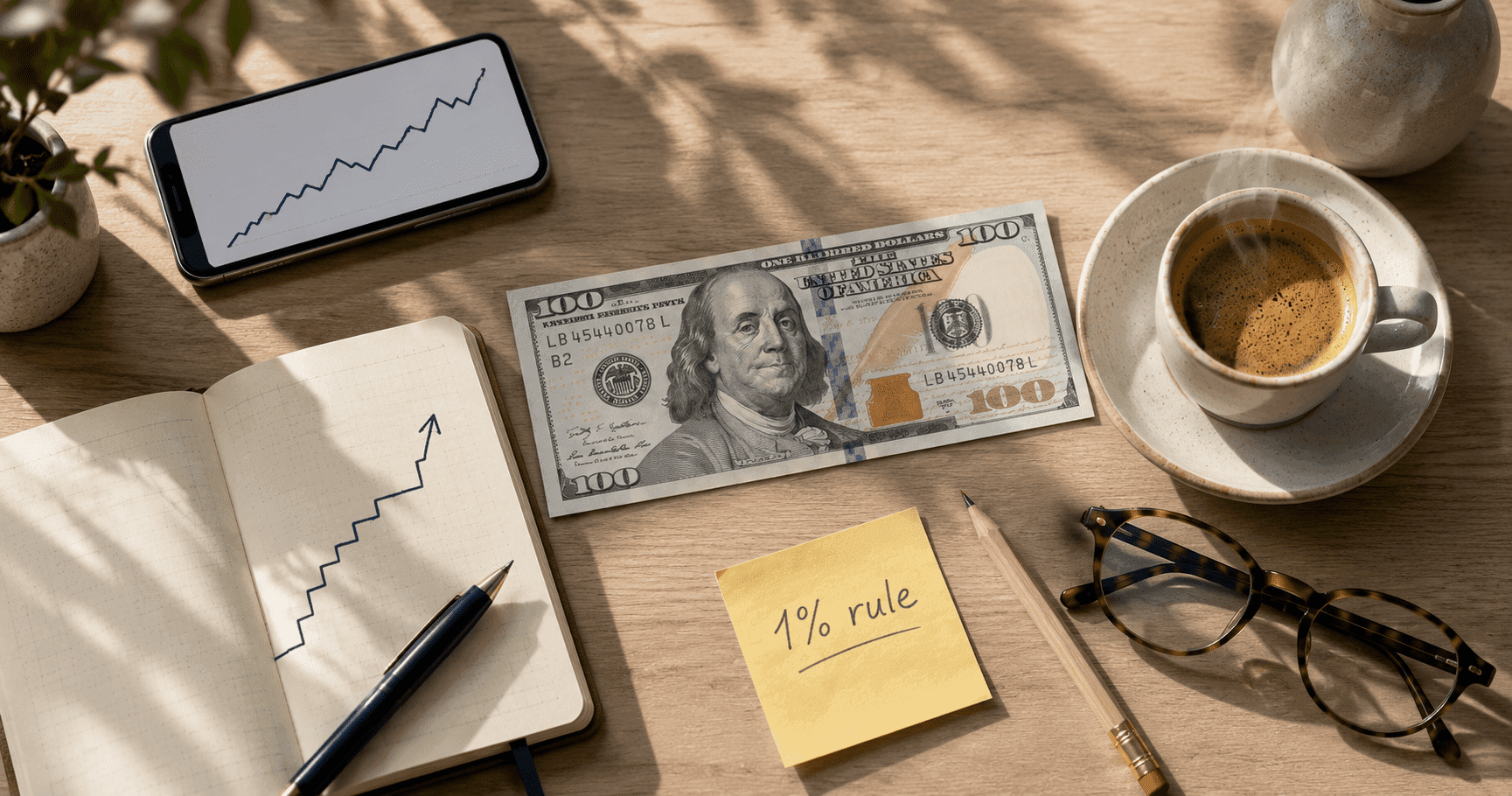
So borrow the one rule the surviving traders actually use. Never risk more than 1% to 2% of your money on a single trade. On a $100 stack, that is one or two dollars of genuine risk per position. It feels absurdly small. That is the point: it keeps you in the game long enough to get better.
Pair it with a stop-loss, an order that automatically sells if the price falls to a level you set in advance. It is the seatbelt. You hope you never feel it work, but you do not drive without it.
What if you only have $50 and the 1% rule feels pointless? Then you are not trading yet, you are practicing. Use that money to learn the buttons on a spot buy and hold. The trading comes later, once the habits are boring.
The 2026 tax trap that punishes overtrading
Here is the thing the hype accounts will never tell you: in 2026 the paperwork itself now penalizes trading often.
Every buy and sell is usually a taxable event. Trade 200 times and you have 200 lines to report. And starting with the 2025 tax year, the rules got stricter on all three sides of the Atlantic.
In the US, exchanges now issue Form 1099-DA reporting your crypto sales to both you and the IRS. For assets bought from January 1, 2026, brokers must also report your cost basis. (cost basis is what you originally paid, used to work out your gain.) If you moved coins between wallets, that form can show a $0 cost basis, making your gain look bigger than it was unless you kept records.
In the UK and across the EU, the OECD’s Crypto-Asset Reporting Framework kicked in on January 1, 2026, so platforms now hand your transaction data straight to HMRC and other tax authorities, with the first reports due in 2027. The era of “they will never see it” is closing. I covered the moving parts in my crypto regulation breakdown if you want the regulatory detail.
Here is how the tax side compares for a beginner across the three regions.
| Level | US | UK and EU |
|---|---|---|
| Easy | Expect a Form 1099-DA from your exchange by mid-February; keep your own purchase records. | Assume your platform now reports to HMRC or your EU tax authority under CARF; keep records too. |
| Smart | Track cost basis per wallet; the IRS dropped the universal pooling method. | UK gives a £3,000 annual capital gains exemption; know your country’s allowance before you sell. |
| Pro | Reconcile any $0-basis line on Form 8949 so you are taxed on real gains, not gross proceeds. | Match every disposal to declared figures, since mismatches are exactly what triggers a review. |
None of this is tax advice, and I am not an accountant. The simple takeaway: fewer trades means fewer taxable events, cleaner records, and less audit risk. The lazy strategy is the compliant one too.
Here’s what I’d actually do
Buy one major coin on a regulated exchange. Risk one to two percent per trade, with a stop-loss. Keep every record.
That’s the whole list.
The reason this reads like anti-advice is that real crypto trading for beginners is mostly about not blowing up before you learn anything. The 7% who last are not smarter. They are more boring, and boring compounds.
Start with $100 you can afford to lose. Treat the first year as tuition, not income. If you still enjoy it after twelve quiet months, then you have earned the right to do more.
The market will always be there tomorrow. Most beginners won’t be, and that is a choice, not bad luck.
Sources
- Bank for International Settlements, Bulletin No 69, Crypto shocks and retail losses (2023), bis.org
- 2025 survey of 1,005 first-year retail crypto traders, nftevening.com
- US Internal Revenue Service, digital assets and Form 1099-DA reporting (2026), irs.gov
- HM Revenue & Customs, tax on cryptoassets and CARF reporting (2026), gov.uk
- European Union, Markets in Crypto-Assets (MiCA) and DAC8 framework (2026), finance.ec.europa.eu
Keep learning: browse all our crypto and forex guides.

Arpit Soni
Founder and Editor in Chief
Thewealthora was started to do one thing: take the money questions people actually ask and answer them in plain English, with the arithmetic shown and the catch stated rather than buried.