Is XRP a good investment in 2026? The honest $1.40 answer

In April 2025, Standard Chartered told the world XRP would hit $8 by the end of 2026. Ten months later, the same bank quietly cut that number to $2.80.
That single revision tells you more about whether XRP is a good investment than any price-target screenshot you have seen on X. The bullish forecast everyone keeps quoting is the one the bank that made it already walked back.
Standard Chartered slashed its 2026 XRP target by 65%, from $8 to $2.80, after XRP crashed to $1.16 in February.
So is XRP a good investment in 2026, or just a very good story trading at a $1.40 price tag? That is the honest question, and the honest answer takes more than a green candle. Let me walk you through what XRP actually does, what the forecasts really say once you read the footnotes, and the math nobody runs before they buy.
What XRP actually is, and the one job it was built for
XRP is the native token of the XRP Ledger, a blockchain launched in 2012 by David Schwartz, Jed McCaleb, and Arthur Britto. The same people went on to build the company that became Ripple. Two things, one origin story, and people mix them up constantly.
Here is the part that matters. XRP was built to do one boring, valuable thing: move money across borders faster and cheaper than the banking system’s existing plumbing.
That plumbing is called SWIFT (society for worldwide interbank financial telecommunication), the messaging network banks use to shuffle money internationally. A SWIFT transfer can take days. The XRP Ledger settles a transaction in 3 to 5 seconds, at a cost of roughly $0.0002 per transfer, handling up to 1,500 transactions per second.
Think of it like the difference between mailing a cheque and tapping your phone at a card reader. Same money, wildly different speed. That speed is the entire investment thesis, so before you ask whether XRP is a good investment, you have to ask whether banks will actually use that speed at scale. Hold that thought.
Is XRP a good investment, or just a very good story?
Stories are cheap in crypto. Price is not. So look at what XRP has actually done lately, not what it promises.
XRP hit an all-time high of $3.65 on July 18, 2025. As of mid-May 2026 it trades around $1.40. That is a drop of about 62% from the peak, and it now sits at number 5 by market value, around $85 billion, on roughly 61.8 billion tokens in circulation.
The lead-in to this chart is simple: this is a coin that gave a lot of people a very bad year. Any honest take on whether XRP is a good investment has to start there, with the loss, not the moonshot.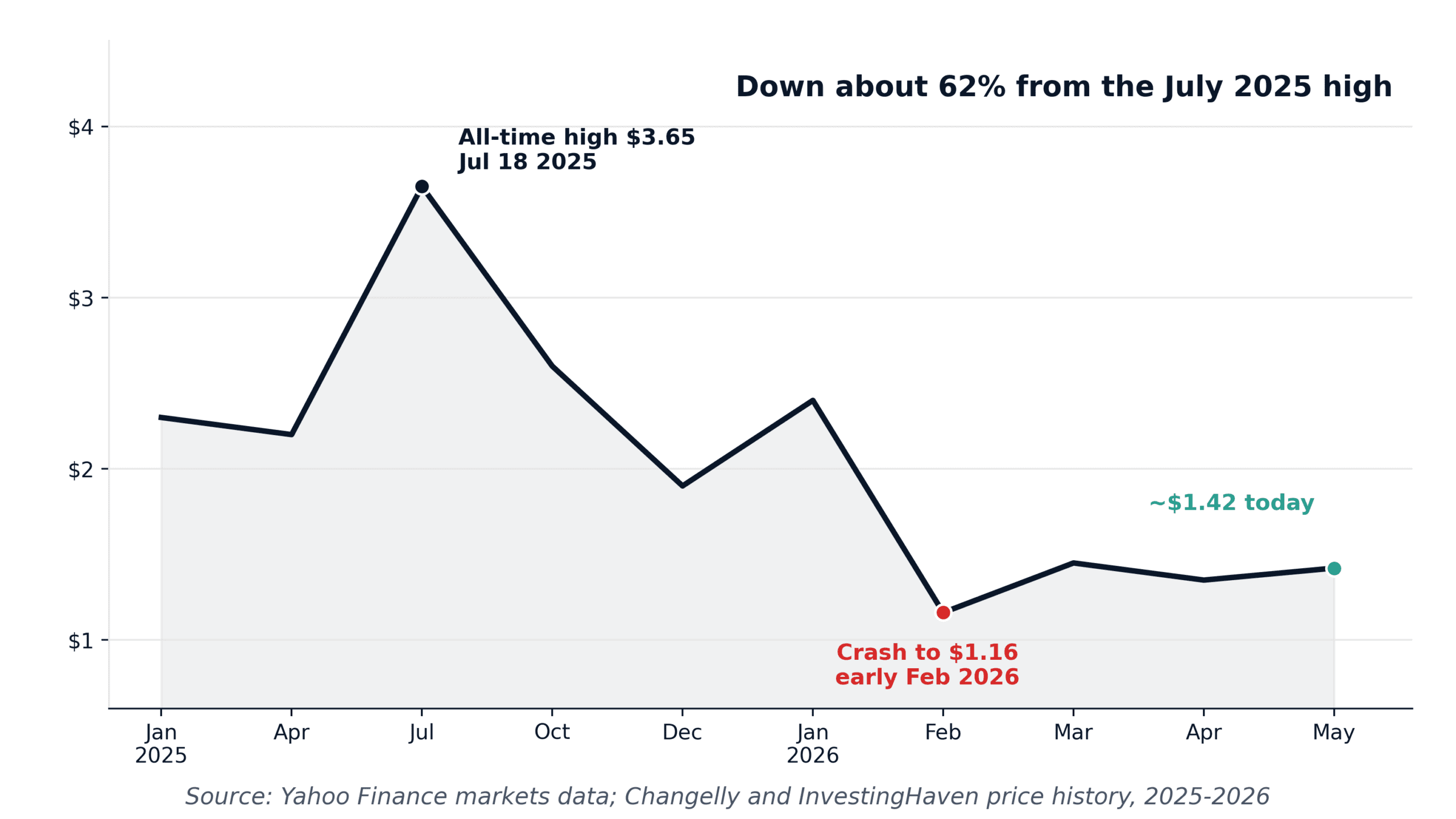
2025 closed near $1.90. January 2026 popped to $2.40, February gut-punched holders down to $1.16, and a brief May rally to about $2.50 fizzled back toward $1.40. XRP is down roughly 27% in the first quarter of 2026 alone. The Fear and Greed Index reading sat at 28, squarely in fear territory.
So is XRP a good investment after a slide like that? It depends entirely on which version of XRP you are buying: the payment network with real bank pilots, or the meme that 5 million people screenshot on weekends. Those are not the same asset, and confusing them is how beginners quietly get drained.
One thing I will admit up front. I cannot tell you where XRP closes 2026, and neither can anyone with a price-target thread. Anyone who speaks in certainties about a coin that moved from $1.16 to $2.50 to $1.40 in three months is selling you something.
The Standard Chartered forecast everyone quotes, and the part they skip
Standard Chartered is the only major global bank with a public, named XRP price target. Geoffrey Kendrick, its global head of digital assets research, published the original roadmap in April 2025: $8 by the end of 2026, climbing toward $28 by 2030.
That $8 number went viral. The revision did not.
In February 2026, after the crash, Kendrick cut the 2026 target to $2.80, the largest percentage cut across all of the bank’s crypto forecasts. He kept the long game intact though, nudging 2028 to $12.60 and holding 2030 at $28.
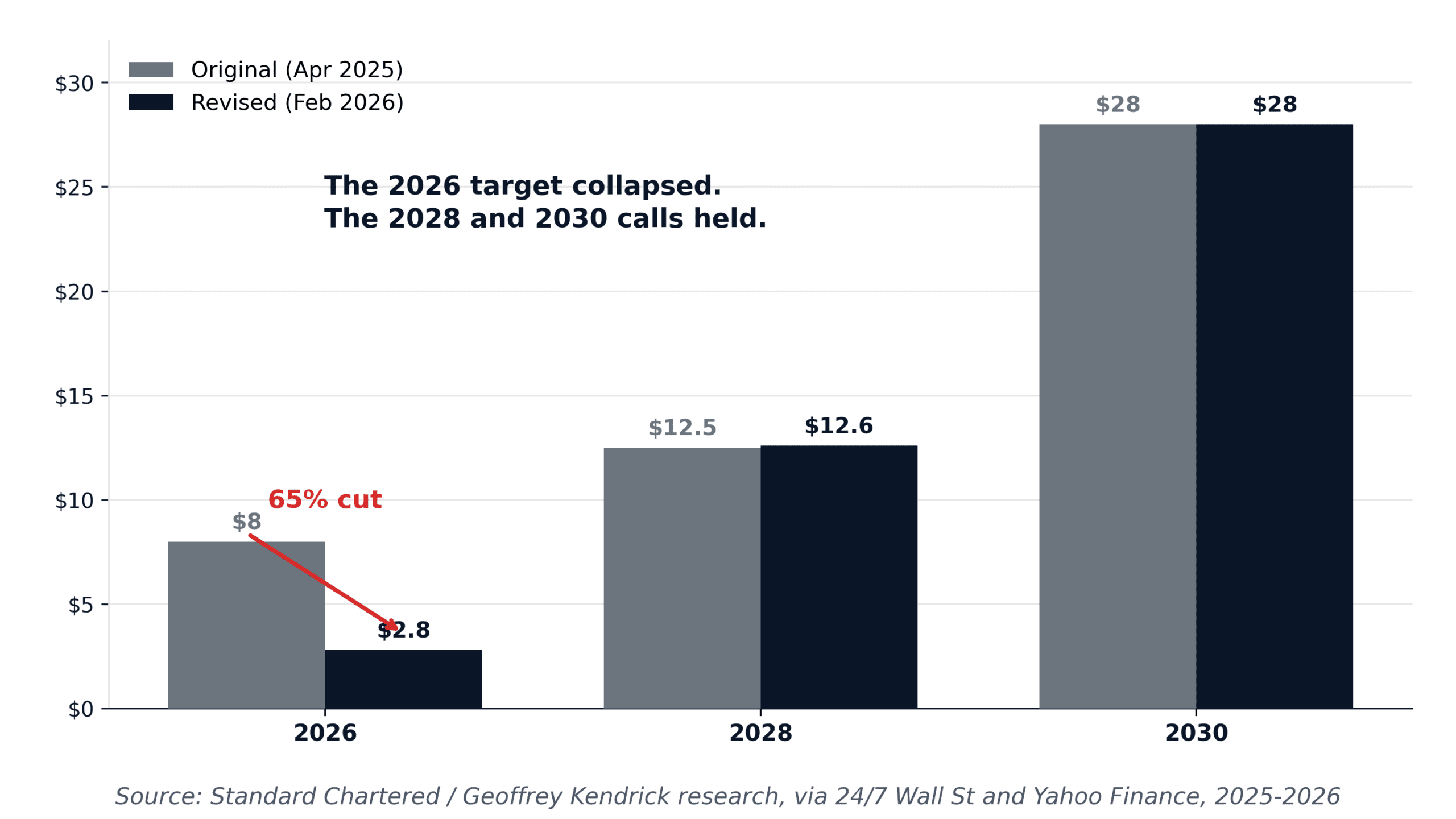
Read that chart carefully, because it is the most honest single picture of the XRP investment case. The near-term call collapsed. The long-term call survived. Kendrick’s own words, paraphrased from his note, were that the market was capitulation-prone and would set up better later in the decade.
And the $28 target is not a vibe. At $28, XRP’s market value would be around $1.71 trillion, near Bitcoin’s October 2025 peak. For XRP to reach $28, it would need to stop being a trading asset and become core global financial infrastructure. Possible. Not casual.
Standard Chartered is not the whole market, though, and a fair read of whether XRP is a good investment needs the other voices too. The broader analyst consensus for end-2026 clusters lower, roughly $2.50 to $6, with The Motley Fool floating a more grounded $3 target. Prediction markets, meanwhile, put about a 44% chance that XRP simply ends 2026 near $1 if the wider economy stumbles. So the honest range runs from “barely moved” to “tripled,” which is exactly the kind of spread that should make you size carefully.
So when someone asks me if XRP is a good investment based on “the Standard Chartered $8 call,” I tell them the bank itself disagrees with that number now. The detail matters more than the headline. Is XRP a good investment if even its loudest bank backer halved the near-term call? Only if you are buying the long-term rail story, not the 2026 pop.
What “5,000 XRP” is actually worth, with the math nobody runs
This is the search that breaks my heart a little. People type “5000 XRP future value” expecting XRP to hit $5,000 a coin. That is not what it means. It means: what is a stack of 5,000 tokens worth at different prices?
Let me run the actual numbers, because hope is not a position size. Knowing how to start small and add steadily beats any forecast.
| Your XRP stack | Today (~$1.40) | $2.80 (SC 2026) | $5.00 | $12.50 (SC 2028) |
|---|---|---|---|---|
| 1,000 XRP | $1,400 | $2,800 | $5,000 | $12,500 |
| 5,000 XRP | $7,000 | $14,000 | $25,000 | $62,500 |
| 10,000 XRP | $14,000 | $28,000 | $50,000 | $125,000 |
So 5,000 XRP today is about $7,000, not a Lamborghini. So is XRP a good investment at that stack size? At today’s price it is a $7,000 bet, and the answer depends entirely on the next leg, not the screenshot. At the revised $2.80 target, 5,000 XRP is worth $14,000, a clean double, not a 1,000x. At Standard Chartered’s $12.50 stretch for 2028, that same stack reaches $62,500.
That reframes the whole question. Realistic 2026 scenarios imply something like 2x to 5x upside, which is genuine wealth-building, not lottery money. Run those numbers before you decide whether XRP is a good investment for your situation, because the answer shifts hard between a sober 2x and a 1,000x fantasy. If you want a 100x, you needed a coin far smaller than the number 5 asset in the market. People also ask whether XRP can “decouple” from Bitcoin and run on its own. So far it has not. XRP still tracks Bitcoin’s direction closely, so a price decoupling prediction is a bet on a behavior change that has not shown up in the data yet.
Why bank adoption is the only thing that makes XRP a good investment long term
Strip away the price noise and one question decides everything, and it is the same question as whether XRP is a good investment at all: do banks actually settle real money on the XRP Ledger? Because XRP price predictions built on bank adoption are the only ones with a foundation under them.
The most concrete answer arrived in May 2026. JPMorgan, Mastercard, and Ondo Finance settled a cross-border tokenized Treasury transaction on the XRP Ledger in real time. Ripple’s payment network already touches banks in Brazil, India, the Philippines, and the Middle East. That is not a roadmap slide. That is institutions moving value on the rail, the same shift powering on-chain government bonds.
The regulatory weather cleared too. The SEC dropped its long-running case against Ripple in 2025, which means US institutions can now treat XRP as a commodity rather than a legal landmine. Seven spot XRP ETFs (exchange-traded funds, a wrapper that lets you hold XRP through a normal brokerage account) are now live in the US with over $1.2 billion in assets, from names like Franklin Templeton, Bitwise, Grayscale, and Canary.
Here is the catch, and it is a big one. Weekly ETF inflows have collapsed from about $200 million to roughly $2 million. The wrapper exists. The demand walked out of the room. Whether XRP is a good investment from here rests almost entirely on that number turning back up, which Standard Chartered says needs inflows to scale past $4 billion to justify the higher targets.
There is a competitor risk worth naming here too. Stablecoins, digital tokens pegged one-to-one to the dollar, do the same cross-border job XRP was built for, and the stablecoin market has swelled past $320 billion. If banks decide a dollar-pegged token is simpler than a volatile bridge asset, XRP’s core use case shrinks. That is the quiet threat under every bullish XRP price prediction tied to bank adoption.
If you trade currencies as well as coins, this will feel familiar, because forex and crypto pull on the same macro risk lever. When the Fed tightens and the dollar firms, speculative money leaves both at once.
The escrow unlock and “activity decline” the bears won’t shut up about
Two scary phrases dominate the bear case: the monthly unlock and the activity decline. Both are real. Both are also widely misread. Is XRP a good investment with a billion tokens unlocking every month? The headline screams no; the mechanics say it barely matters.
Back in 2017, Ripple locked 55 billion XRP into escrow (a cryptographic lockbox that releases funds on a fixed schedule) to calm fears that it would dump its huge stash. Since then, Ripple releases 1 billion XRP from escrow at the start of every month, but relocks 60% to 80% of it almost immediately. In December 2025, about 70% went straight back in, leaving only a few hundred million in play.
So the “1 billion XRP unlock” headline you see monthly is mostly theatre. The net new supply hitting the market is closer to 200 to 300 million tokens a year, and history shows these unlocks barely move the price. The narrative scares people more than the supply does.
The activity decline is the sharper worry. On-chain transaction volume, the actual usage of the ledger, has been soft, and XRP has spent stretches stuck below $2, what traders call the monthly midband. A payment network is only worth something if payments flow through it. If real usage keeps fading while the price leans entirely on ETF speculation, the long-term thesis cracks. That is the single biggest reason XRP is a good investment only with your eyes open, not on faith.
Over on Reddit, the most upvoted take I keep seeing is blunt and basically correct: XRP holders have been promised the moon since 2017, and the people who did best simply sized small and waited. Boring beats hopeful.
Here’s what I’d actually do
Decide which XRP you are buying before you spend a rupee or a dollar. Size the position so a 60% drop does not wreck you. Then ignore every monthly unlock headline for the next year.
That’s the whole list.
XRP is not a scam and it is not a guaranteed retirement. It is a focused bet that banks keep moving real money onto one specific rail, wrapped in a token that swings like a meme in the meantime. The $2.80 revision and the $2 million inflow week are the tells; the JPMorgan settlement is the counter-tell.
So, one more time, plainly: is XRP a good investment in 2026? For a small, risk-aware slice of a diversified portfolio, the case is defensible. As a concentrated bet built on a viral price screenshot, it is not. The asset is the same; the position size is what separates a smart holder from a wrecked one.
If that bet fits your risk and your timeline, a small, deliberate position is defensible. If you are buying because a stranger posted a $5,000 screenshot, you already have your answer.
The market does not pay you for conviction. It pays you for being right about the boring part.
Sources
- Standard Chartered / Geoffrey Kendrick, XRP price target revision, via 24/7 Wall St (2026), 247wallst.com
- Yahoo Finance, XRP and Ripple market coverage (2026), finance.yahoo.com
- Finbold, Ripple monthly escrow unlock analysis (2026), finbold.com
- 24/7 Wall St, what 1,000 / 5,000 XRP could be worth (2026), 247wallst.com
- CryptoNews, spot XRP ETF assets and inflow data (2026), cryptonews.com

Arpit Soni
Founder and Editor in Chief
Thewealthora was started to do one thing: take the money questions people actually ask and answer them in plain English, with the arithmetic shown and the catch stated rather than buried.