Crypto casino: 7 brutal money traps that drain beginners

On 4 September 2023, hackers walked off with $41.3 million from Stake.com, the world’s biggest crypto casino, by lifting a single private key from one of its hot wallets. The casino kept running. The players kept depositing. Almost nobody who reads “best crypto casino” lists today has heard of it.
That’s the problem with the entire crypto casino category. The marketing is loud, provably fair, instant withdrawals, 1% house edge, and the real story sits in the footnotes.
Most crypto casino guides for beginners are written by affiliates earning a kickback on every player they send. The math, the 2026 IRS change, and the legal exposure get skipped because they don’t sell.
Here are the seven traps the affiliate posts won’t tell you about.
The 1% house edge that drains $99 from every $1,000 you wager
The 1% number is the headline crypto sites love. Crypto dice and crash games genuinely run at a 1% house edge (meaning the casino keeps 1 cent of every dollar wagered on average), far lower than slots. But “wagered” isn’t “deposited.”
Here’s the math nobody runs. You deposit $1,000 in BTC and play 1,000 dice rounds at $1 each. Expected loss: $10. Sounds tiny. Then you re-bet your winnings, which is what crash and dice players actually do. After cycling that bankroll 100 times, easy in a single session, your expected loss is closer to $99 from every original $1,000.
It’s the coffee subscription problem. You pay $1, you get $0.99 of coffee, every visit feels nearly free. Visit a thousand times and you’ve handed the shop $10 for nothing. The crypto casino is the same shop, with worse coffee.
The gap between the marketed edge and the session edge gets wider:
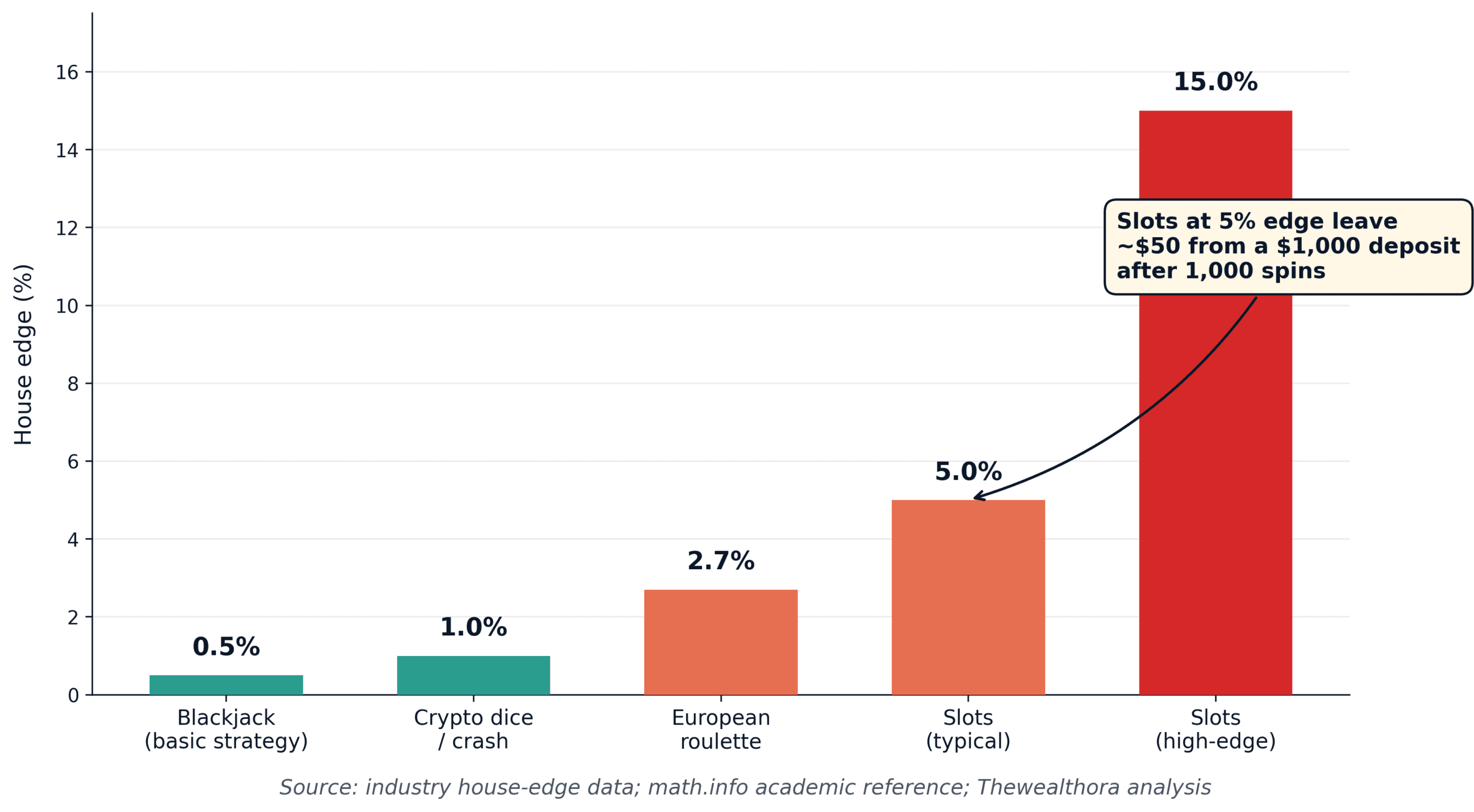
Slots are where the real damage lives. Most crypto casino slots run a 4 to 7% edge, with some hitting 15%. After 1,000 spins on a 5% slot, your $1,000 deposit averages around $50 left. The 1% headline is real. The 1% loss isn’t.
“Provably fair” doesn’t mean what most crypto casino players think
Provably fair is a real piece of cryptography. The casino publishes a hashed seed (a string of code that locks in the round’s randomness before you bet), you add your own seed, and the result is verifiable on-chain after the round. The casino can’t rig the outcome after the fact.
But provably fair doesn’t change the house edge. It just proves the math is being run honestly. A roulette wheel with a verifiable RNG (rng = random number generator) still pays 35-to-1 on a 37-slot wheel. That’s where the 2.7% house edge lives, not in any rigging.
Most beginners hear “provably fair” and think “the casino can’t take my money.” It can. It’s just legally entitled to.
The $41 million reason your crypto casino balance isn’t safe
On 4 September 2023, $41.3 million in ETH, MATIC, and stablecoins moved out of Stake.com hot wallets to addresses later confirmed by the FBI (federal bureau of investigation) as belonging to North Korea’s Lazarus Group. The breach took minutes. Stake’s co-founder Edward Craven said the platform was “back and running exactly as it was” within hours, meaning Stake covered the loss internally.
That’s the part the marketing leaves out. When you deposit BTC into a crypto casino, you’re no longer the wallet holder. The casino is. Your “balance” is a row in their database, and a hot wallet (an internet-connected wallet operators use for fast withdrawals) is by definition a target.
I don’t know which crypto casino will be the next Stake-style hack victim. Neither does the FBI. What I do know is that Stake survived because Stake was enormous. Smaller crypto casinos in the same situation just close, and there is no FDIC equivalent for crypto gambling deposits, no insurance scheme of any kind.
Crypto casino taxes just got 10% more painful in 2026
This is the trap almost no crypto casino review mentions, and it’s the most expensive.
The One Big Beautiful Bill Act (obbba, the federal tax law signed July 4, 2025) changed how the IRS treats gambling losses. Starting January 1, 2026, US filers can only deduct 90% of their gambling losses against their gambling winnings. The other 10% is taxable income, even if you broke even on the year.
Run the math on a typical heavy crypto casino session. You wager $10,000 across the year, you win $10,000 back. Net: zero. Pre-2026 you owed nothing. Now you can only deduct $9,000 of those losses. The remaining $1,000 is taxable as ordinary income. At a 24% bracket, that’s roughly $240 owed on a year you didn’t make a cent.
The Tax Foundation calls this “phantom income.” A break-even player on $1 million of wagers would owe roughly $37,000 to the IRS for making nothing.
The rules cut differently across regions:
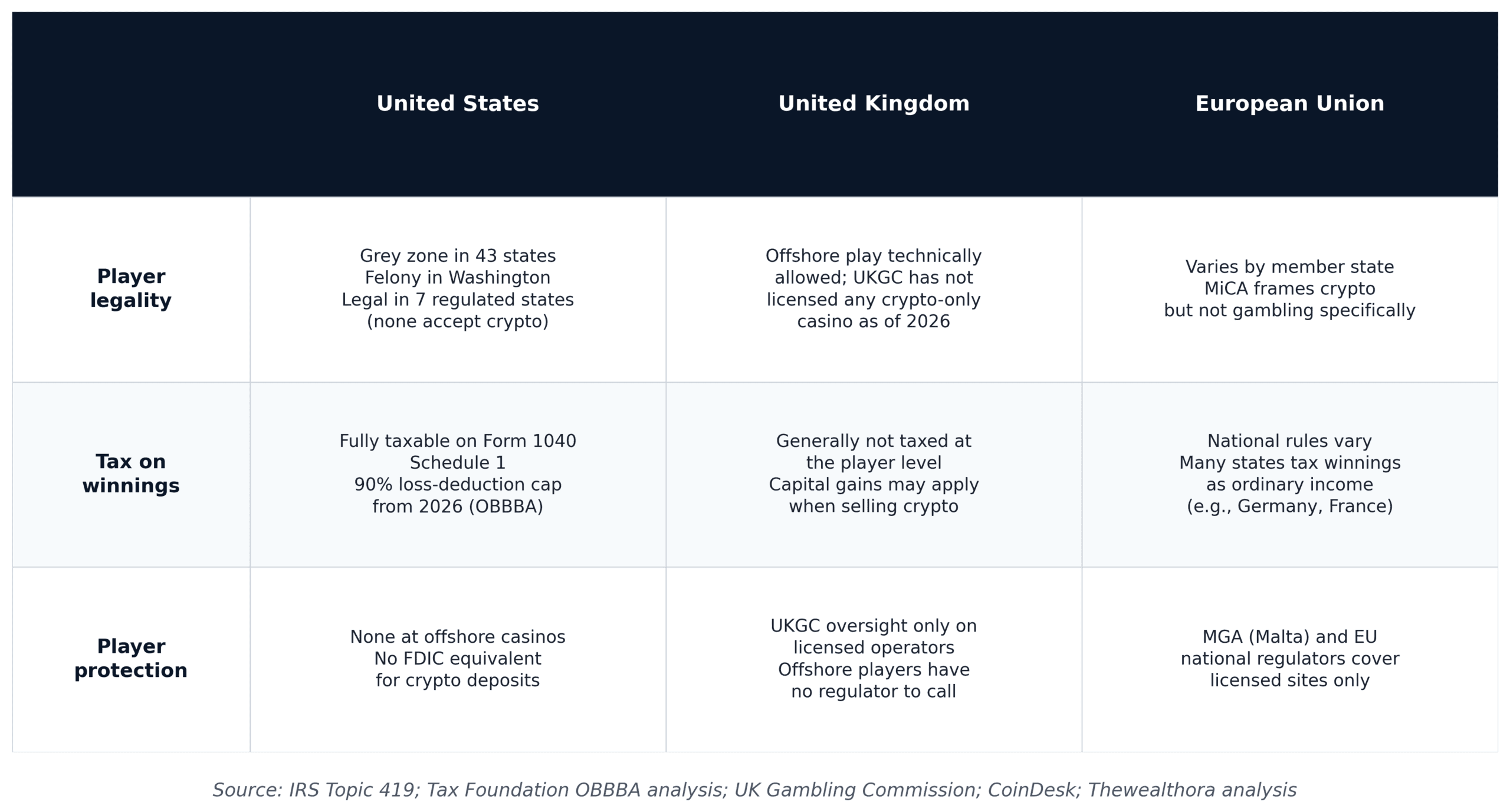
UK and most EU players have it easier on this specific point. The UK doesn’t tax most gambling winnings at the player level at all, which is why HMRC (uk tax authority) stays quiet on crypto casino play. The catch is that you still have crypto-specific capital gains exposure when you eventually sell or swap your winnings. The UK Gambling Commission’s February 2026 announcement on exploring crypto payments at licensed operators only made things less clear, not more.
Why offshore “licenses” don’t protect you when a crypto casino vanishes
Most crypto casino sites flash a Curaçao license badge in the footer. It looks regulatory. It mostly isn’t.
Curaçao licenses cost a fraction of a UK Gambling Commission license, require almost no player-protection infrastructure, and offer no dispute resolution path that matters in practice. If your $5,000 BTC withdrawal gets stuck behind a “verification review” that never ends, the Curaçao Gaming Authority is not picking up your phone call.
That’s the soft version of this trap. The hard version is when an offshore crypto casino just disappears. Domain dies, support email bounces, balances vanish. It happens often enough that “exit scam” is the standard phrase for it.
The patchwork that lets one US state fine you for a single bet
Federal US gambling law mostly targets operators, not players. UIGEA (uigea = the 2006 unlawful internet gambling enforcement act, which bans payment processing for illegal online gambling) goes after banks and processors. The Wire Act covers sports betting across state lines, not casino games.
Then state law gets weird. Washington State criminalises online gambling at the player level. RCW 9.46.240 makes it a Class C felony, punishable by up to five years. Utah and Hawaii ban all forms outright. New York, Florida, Texas, and California are silent on crypto specifically, but their general online gambling bans likely apply.
Seven states have legalised regulated online casinos, and none of them currently allow crypto deposits. So if you’re playing crypto casino games anywhere in the US, you’re either in a grey zone or breaking state law, and that includes the broader crypto regulation shifts of April 2026, which didn’t fix this.
The volatility tax nobody warns you about
You deposit 0.1 BTC at a $90,000 spot price and play to a flat session. You withdraw 0.1 BTC. Bitcoin’s now $76,000. You just lost 15% to volatility, before any house edge.
The reverse can happen too. That’s the affiliate spin. The math is asymmetric for two reasons. First, holding crypto in a casino wallet means you don’t control the keys, so price drops are losses you can’t hedge. Second, every winning round you keep on-platform compounds your volatility exposure, not your USD position.
Stablecoin deposits (usdt or usdc, tokens pegged 1:1 to the US dollar) dodge this trap. Most beginners don’t use them.
Here’s what I’d actually do
Skip every “best crypto casino” list. Stop conflating crypto with gambling. Take the same dollars and put them somewhere they compound.
That’s the whole list.
The reason crypto casino marketing works on beginners is that it borrows the language of crypto investing, low fees, transparent, decentralised, and bolts it onto a product where the long-run math guarantees you lose. Investing has its own risks. The big difference is that buying VTI or BTC and holding isn’t designed to take your money on every click.
Beginners who got serious about wealth almost always followed two simple paths. The first was a real $25-a-week investing plan that compounds. The second was the money habits that actually build wealth. Neither involves a casino.
Money you can’t afford to lose isn’t fun money. It’s just money.
Sources
- Internal Revenue Service, Topic No. 419, Gambling Income and Losses, irs.gov
- Tax Foundation, “The One Big Beautiful Bill Act Creates Unequal Tax Treatment for Gambling Losses” (Sept 2025), taxfoundation.org
- TRM Labs, “FBI Confirms North Korea Was Behind $41 Million Stake.com Exploit” (2024), trmlabs.com
- CoinDesk, “UK’s Gambling Watchdog Explores Allowing Gamblers to Pay Bets With Crypto” (Feb 2026), coindesk.com
- RSM US, “Big Beautiful Bill Brings Big Tax Reporting Changes for Casino Industry” (Jan 2026), rsmus.com

Arpit Soni
Founder and Editor in Chief
Thewealthora was started to do one thing: take the money questions people actually ask and answer them in plain English, with the arithmetic shown and the catch stated rather than buried.