On-chain government bonds: a brutal $15B you mostly can’t buy

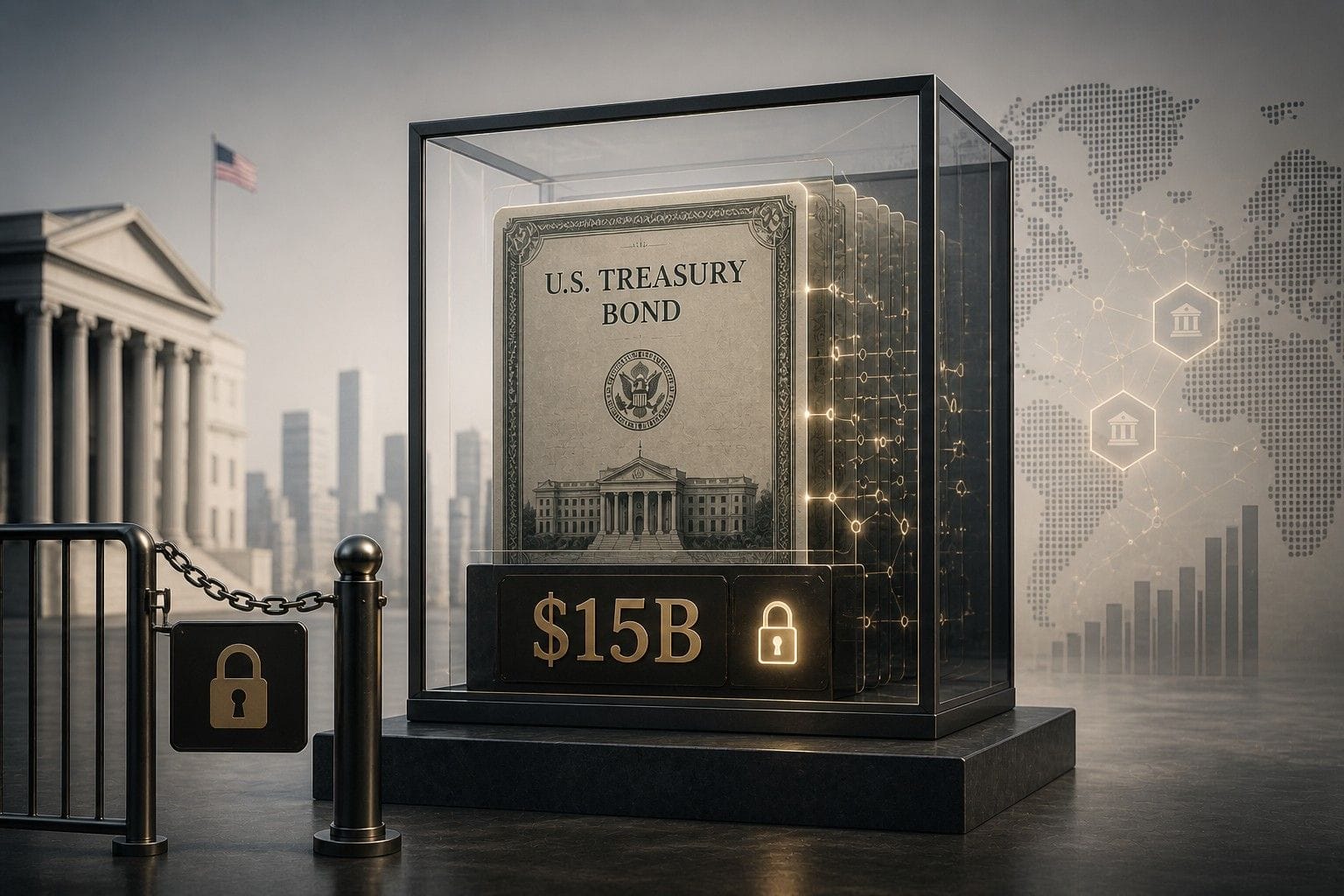
On May 1, 2026, the tokenized U.S. Treasury market crossed $15.20 billion. That’s not a press release headline. That’s the live number on rwa.xyz, the tracker that institutional traders actually watch.
Three years ago, on-chain government bonds were a $400 million experiment that crypto Twitter mostly ignored. Now BlackRock, Circle, Franklin Templeton, and Janus Henderson are running products with real money in them. The UK Treasury just hired HSBC to issue actual digital gilts (UK government bonds) directly on a blockchain.
Here’s the part nobody puts on the marketing slide: most of that $15 billion belongs to institutions, and retail access is still mostly an illusion.
If you’re a regular investor in New York or London who heard about BUIDL on a podcast, this guide is the version I wish someone had handed me. No hype, no “future of finance” filler. Just what on-chain government bonds actually are in May 2026, what you can and can’t buy, and what to do about it.
What on-chain government bonds actually are
On-chain government bonds are exactly what they sound like, but the plumbing matters more than the label. A traditional T-bill (short-term U.S. government IOU) sits in a custodian’s database somewhere. A tokenized one sits as an entry on a blockchain, usually Ethereum or Solana.
Think Spotify versus a CD. The song is the same. The delivery system is different.
Three structures dominate the market today. Tokenized fund shares (BUIDL, BENJI) are shares of a regulated money-market fund holding T-bills, recorded on chain. Tokenized notes backed by Treasuries (Ondo’s USDY) are corporate IOUs collateralized by short-term U.S. government debt. Digitally native sovereign bonds (the UK’s DIGIT) live only on the blockchain, with no paper twin.
The first two dominate today’s $15 billion in on-chain government bonds. The third is where the real disruption is heading.
How fast the on-chain government bonds market grew
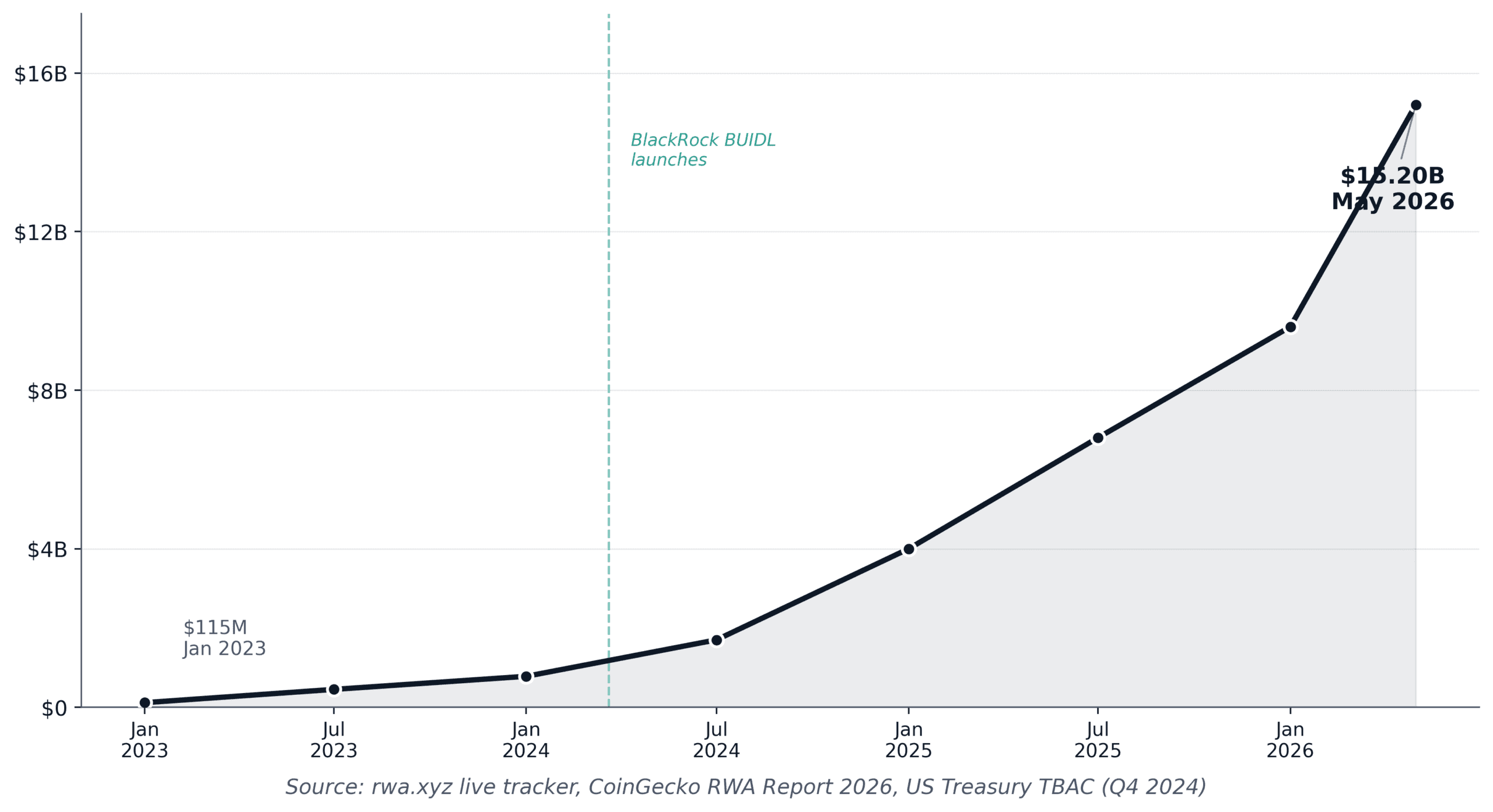
In January 2023, tokenized Treasuries totaled around $115 million. By May 2026, the number is $15.20 billion. That’s a 132x move in 28 months, and the chart below shows where the inflection points actually landed.
The take-off year was 2024.
In May 2026, rwa.xyz tracks 71 distinct on-chain government bonds products held across 58,658 unique wallet addresses.
The average position is roughly $260,000. This is not retail money. It’s mostly DAO treasuries (crypto-native organizations holding shared funds), hedge funds, market makers, and family offices using these tokens as 24/7 collateral. Circle CEO Jeremy Allaire calls tokenized Treasuries as collateral “a major emerging use case,” and the on-chain data agrees.
The 5 products that own 72% of the market
Five issuers now hold roughly $11 billion of the $15.20 billion total.
- Circle’s USYC ($2.91B). Backed by short-term Treasuries, used heavily as collateral on BNB Chain via Circle’s $1.84B Binance partnership.
- BlackRock’s BUIDL ($2.58B). Issued through Securitize, lives on 8 blockchains, has paid over $100 million in dividends since its March 2024 launch.
- Ondo’s USDY ($2.14B). Non-U.S. only, accessible through MetaMask, pays roughly 4% APY.
- Franklin Templeton’s BENJI ($2.05B). The FOBXX share class on chain, $20 minimum, the most retail-friendly of the bunch.
- Janus Henderson’s JTRSY ($1.24B). Managed with Centrifuge, S&P AA+ rated, popular with DAO treasuries.
Yields range from roughly 3.36% to 5.25% across the sector. Fees range from 0.15% (BENJI) to 0.50% (BUIDL institutional class).
The takeaway is uncomfortable. If you’re a U.S. retail investor, BENJI is the only on-chain government bonds product you can buy directly today. Everything else is gated by accreditation rules, $5,000 minimums, or jurisdiction blocks.
Why the UK just changed the game (DIGIT, February 2026)
On February 12, 2026, HM Treasury named HSBC’s Orion platform as the technology provider for the UK’s Digital Gilt Instrument pilot. DIGIT will be the first G7 sovereign bond born on a blockchain rather than tokenized after the fact.
Lucy Rigby, the UK’s Economic Secretary to the Treasury, framed it as wanting to “capitalise on this technology, deliver efficiencies and reduce costs.” Two things make this different from BUIDL.
First, the blockchain ledger is the legal record of ownership, not a copy of one held elsewhere. Second, the issuer is the Treasury itself, not a fund manager wrapping someone else’s debt.
Here’s how access stacks up across regions today:
| Approach | US | UK | EU |
|---|---|---|---|
| 1. Easy | Buy SHV in your IRA, skip on-chain entirely | Buy a gilt fund in your ISA, skip on-chain | Short-dated EU sovereign bond ETF in a Sparplan |
| 2. Smart | BENJI from $20 if you already have a wallet | Wait for DIGIT retail Phase 2 (not yet open) | Ondo USDY through MetaMask (non-US only) |
| 3. Pro | BUIDL or OUSG via Securitize if accredited | Institutional access via Digital Securities Sandbox | Tokenized money-market funds via licensed crypto custodians |
The UK pilot is small, sealed inside a regulator’s sandbox, and short-dated. But it sets the legal template for every G7 government that follows. If DIGIT works, on-chain government bonds stop being a crypto-native novelty and become real sovereign infrastructure. (You can read more about the latest crypto regulation news shaping this shift.)
What you actually earn (and what the fees eat)
Look past the marketing pages and on-chain government bonds pay roughly the same as their boring offline cousins.
The underlying yield is whatever short-term U.S. Treasuries are paying, about 4.2% in early May 2026. From that, the fund manager subtracts a fee. BENJI charges around 0.15%. BUIDL charges 0.20% to 0.50% depending on share class. Ondo’s USDY monetizes a minting delay instead of charging a stated fee.
Net yield across on-chain government bonds averaged 3.36% over the first week of May 2026.
Take $10,000 sitting in stablecoins. Move it to BENJI at a 0.15% fee and a 4% gross yield, and you earn roughly $385 a year before taxes. The same $10,000 in plain USDC earns nothing. The same in a Vanguard money-market fund earns about $400, but the wallet flexibility goes away.
The catch on chain: the fund pays you in tokens, not in your brokerage cash account, and the IRS still treats every token receipt as ordinary income. (For a sense of how that compares to other yield strategies, the dividend stocks passive income math tells a similar tax story.)
If you’d rather skip all that, Treasury ETFs like SHV do the same job inside your IRA, no wallet required.
The risks nobody puts on the marketing page
The U.S. government almost certainly pays its bills. The smart contract above it is another story.
Three risks rarely make it into the polished investor decks.
- Smart-contract bugs. Every token wrapper is code. Code has bugs. A flaw in an issuer’s redemption contract could freeze access to your tokens even if the underlying T-bills are fine.
- Redemption delays. Most funds promise instant redemption, but most also have fine print allowing 24-hour or longer delays in stress conditions. BUIDL’s institutional redemption minimum is $250,000.
- Bankruptcy remoteness. If the issuer (Securitize, Ondo, Franklin) goes bankrupt, your claim depends on the legal structure of the special-purpose vehicle (the legal shell that actually holds the T-bills). Read the prospectus. Most retail buyers don’t.
I’ll admit the second one caught me off guard. I assumed instant meant instant. Most of these products technically allow next-business-day redemption when markets are stressed.
On-chain government bonds carry one risk no traditional T-bill has: the issuer can be hacked.
Here’s what I’d actually do
If you’re a U.S. retail investor in May 2026, here’s the honest path.
Skip on-chain government bonds for now if you don’t already hold crypto.
Open a brokerage and buy SHV.
Save the wallet for something it actually does better.
That sounds dismissive. It isn’t.
Holding on-chain government bonds makes sense when you already have crypto sitting in a wallet earning nothing, and you want a 24/7 yield-bearing parking spot for it. BENJI at $20 minimum is the cleanest retail entry. Beyond that, the institutional collateral use case is what’s actually driving the $15 billion market, and that’s not your trade.
If you’re crypto-native and your stablecoins are sitting idle, BENJI or BUIDL (if you qualify) beats USDC every time on yield. If you’re TradFi-native, your IRA and a plain Treasury ETF still wins. (And if you’re new to investing entirely, a starter $25 investing plan is a better first move than chasing on-chain yield.)
The future of fixed income runs on rails. You don’t have to ride them yet.
Sources
- RWA.xyz, Tokenized U.S. Treasuries Live Dashboard (May 2026) · rwa.xyz
- HM Treasury / GOV.UK, Update on the Procurement for Digital Gilt Instrument (DIGIT) Pilot (12 February 2026) · gov.uk
- HSBC Holdings plc, HSBC Orion Awarded DIGIT Platform Mandate (12 February 2026) · hsbc.com
- CoinGecko Research, RWA Report 2026 · coingecko.com
- U.S. Treasury / TBAC, Digital Assets and the Treasury Market Presentation (Q4 2024) · home.treasury.gov
- Securitize / BlackRock, USD Institutional Digital Liquidity Fund (BUIDL) · securitize.io

Arpit Soni
Founder and Editor in Chief
Thewealthora was started to do one thing: take the money questions people actually ask and answer them in plain English, with the arithmetic shown and the catch stated rather than buried.