Dow Jones ETF: 30 stocks, 1 brutal flaw most beginners miss

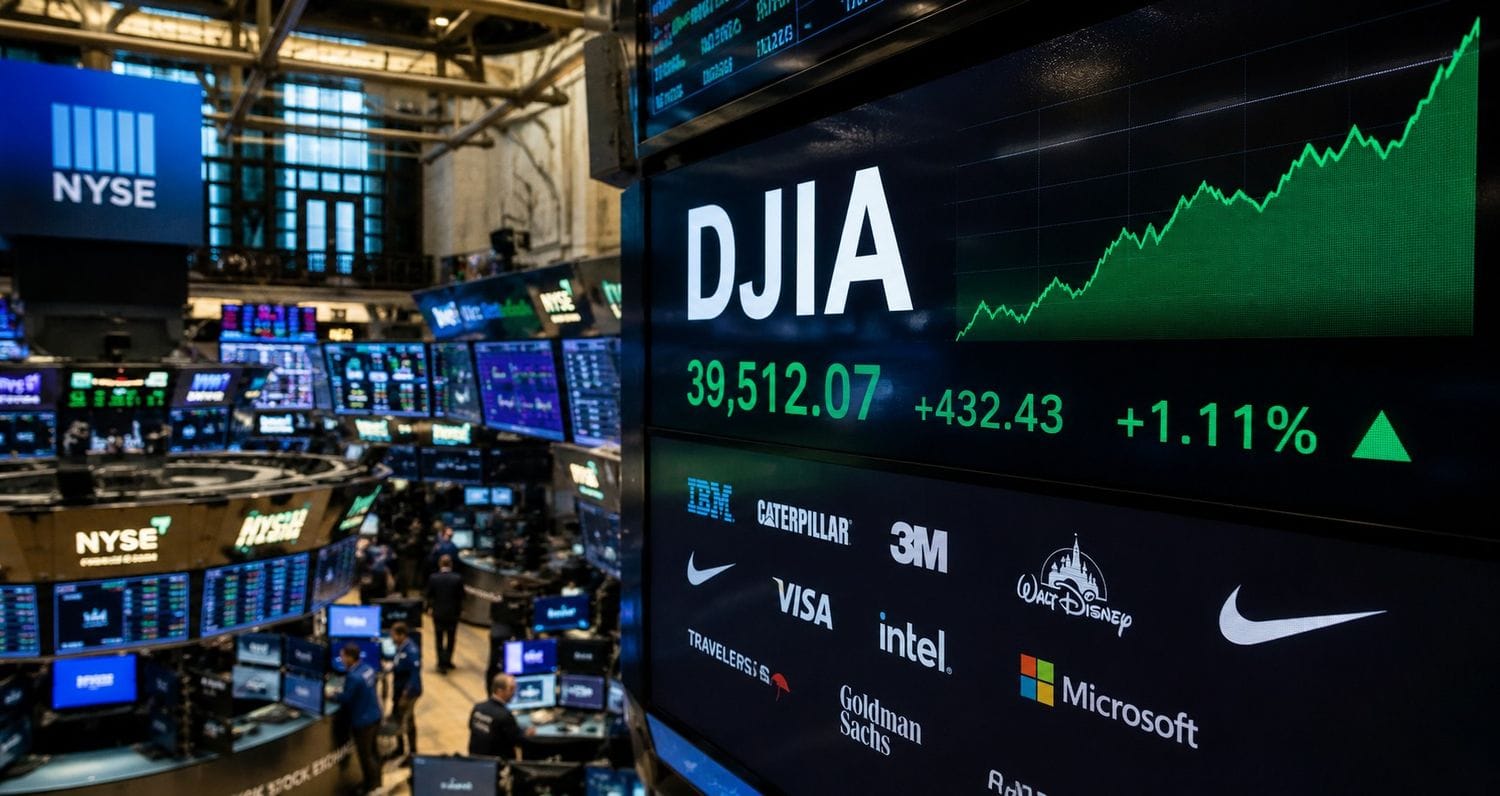
On January 31, 2026, the SPDR Dow Jones Industrial Average ETF Trust held $43.13 billion in assets. Two of its 30 stocks, Goldman Sachs and Caterpillar, accounted for 22.75% of that money.
That’s the part of the Dow Jones ETF story that ranking guides skip. They’ll tell you DIA tracks “the 30 blue-chip giants of America.” They won’t tell you that buying a Dow Jones ETF means writing a check where roughly 23 cents of every dollar lands on two companies you almost certainly didn’t pick on purpose.
The Dow Jones is the most quoted index on Earth and one of the least sensible to actually own as a core holding.
Let me show you why, what the four real Dow Jones ETF options are (US, UK, EU, India, and Africa included), and the one alternative most beginners should pick instead.
The brutal flaw nobody warns you about: two stocks, 22% of the index
The Dow Jones Industrial Average was designed in 1896. That’s not me being cheeky. It was started by Charles Dow and Edward Jones, the founders of The Wall Street Journal, with 12 stocks and a fountain pen. They averaged the share prices, divided by 12, and called it a day.
130 years later, the math hasn’t fundamentally changed. The Dow is still price-weighted (each stock’s influence on the index is set by its share price, not by how big the company actually is). It’s the only major US index still calculated this way.
Why does that matter for a Dow Jones ETF?
Per the SEC NPORT filing for DIA dated January 31, 2026, Goldman Sachs accounts for 11.47% of the fund. Caterpillar accounts for 11.28%. Two companies. Nearly 23% of your money.
Goldman Sachs is the most influential stock in your Dow Jones ETF, not because it’s the biggest company in America, but because its share price happens to be high.
Apple, with a roughly $3 trillion market cap, sits at around 3.3% of DIA. Goldman Sachs, worth a fraction of that, dominates the fund because Goldman trades near $720 a share while Apple trades near $260.
Here’s the easiest way to picture it: imagine ranking grocery stores by the price of one apple at each checkout. Whichever store sold the priciest apple wins the ranking, regardless of how big the store is or how many things it sells. That’s the Dow.
So when a Dow Jones ETF goes up 1%, you’re not really watching America go up 1%. You’re watching whatever Goldman Sachs and Caterpillar did that day. Which is also why this fund behaves more like a quirky concentrated bet than a diversified market index. I covered a similar narrow-exposure trap in how to invest in renewable energy in 2026. When a fund hangs on a small number of bets, the math gets loud fast.
The concentration only becomes obvious when you actually look at the holdings.
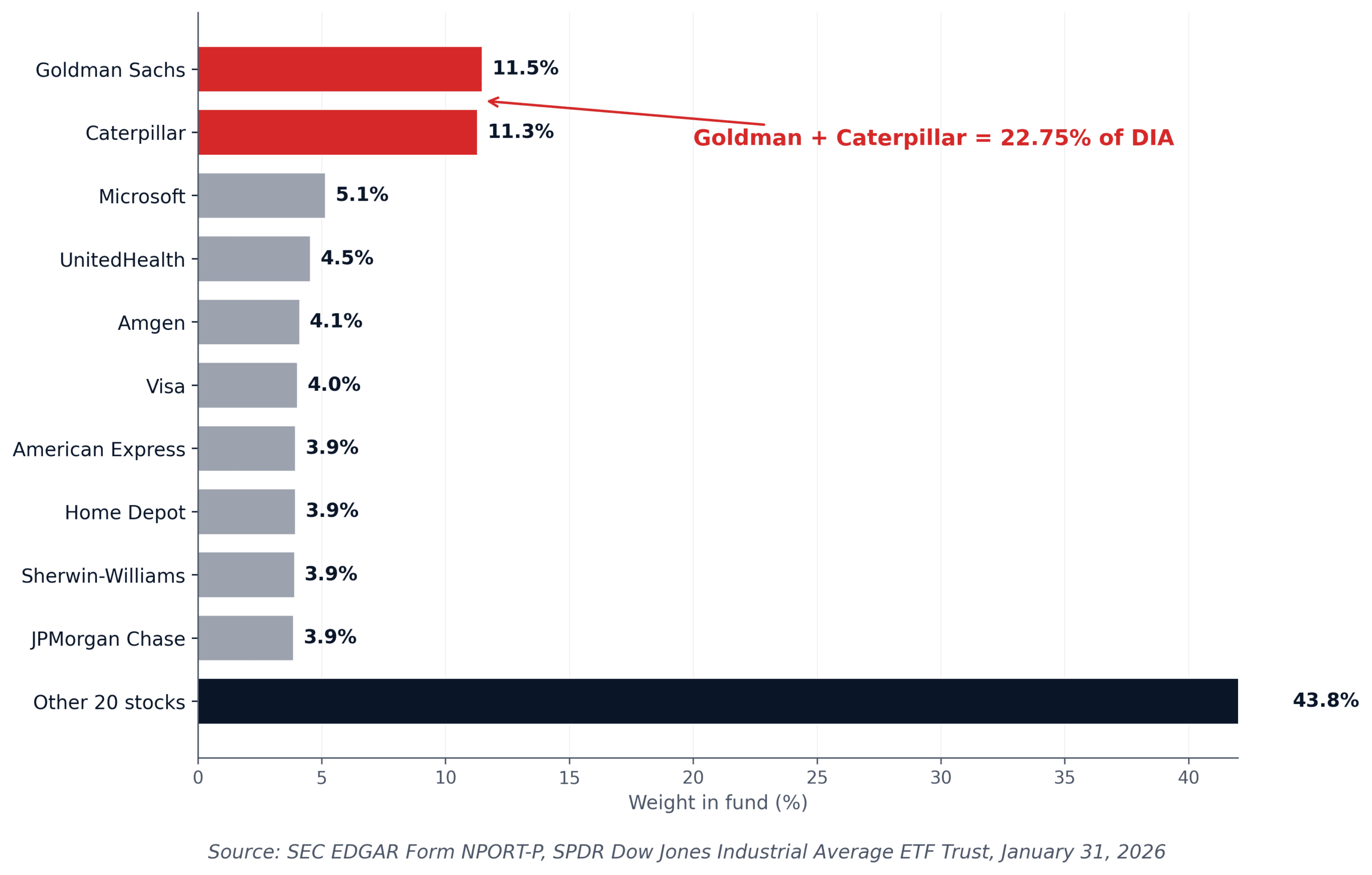
The blue bars are the seven companies that together carry more than half the fund. The grey bars are the other 23 names, fighting for the leftover scraps. That’s your Dow Jones ETF.
The only pure Dow Jones ETF in 2026 (and 3 strategic tilts to know)
Despite the index being 130 years old, there is exactly one ETF that purely tracks the Dow Jones Industrial Average: the SPDR Dow Jones Industrial Average ETF Trust (DIA), also nicknamed “Diamonds.” Everything else is a tilt, a strategic twist on the same 30 names.
Here are the four Dow Jones ETFs worth knowing, with the live numbers as of early May 2026:
| Ticker | Fund name | Expense ratio | AUM | Weighting | Best for |
|---|---|---|---|---|---|
| DIA | SPDR Dow Jones Industrial Average ETF Trust | 0.16% | $43.1B | Price-weighted (pure Dow) | Anyone who actually wants the Dow |
| DJD | Invesco Dow Jones Industrial Average Dividend ETF | 0.07% | ~$440M | Dividend-yield weighted | Income-tilt investors |
| EDOW | First Trust Dow 30 Equal Weight ETF | 0.50% | ~$290M | Equal weight (3.33% each) | Beating the concentration flaw |
| IYY | iShares Dow Jones US ETF | 0.20% | ~$2.1B | Market-cap (broader US, not DJIA) | Broader US exposure, not the Dow |
DIA is the default. State Street’s $43 billion vehicle, 0.16% expense ratio, the actual Dow. If you genuinely want the 30 Dow stocks weighted exactly the way the index weighs them, this is the only Dow Jones ETF that does it.
DJD is the dividend tilt. Same 30 stocks, but weighted by dividend yield instead of share price. It’s mathematically a saner build than DIA for an income-focused investor, and at 0.07% it’s the cheapest Dow ETF on the market. The full case for dividend strategies (and the brutal truths most income blogs hide) is in my dividend stocks passive income breakdown.
EDOW is the equal-weight fix. First Trust’s Dow 30 Equal Weight ETF assigns each of the 30 companies the same 3.33% slot. The price-weighting flaw mathematically disappears. The cost is a higher expense ratio (0.50%) and lower trading liquidity.
IYY isn’t actually a DJIA tracker, which is the part most ranking guides bury. It follows the broader Dow Jones US Index, around 1,000 companies, not the 30 in the Dow Jones Industrial Average. Lumping IYY in with “Dow Jones ETFs” is technically a stretch. Most lists do it anyway, so it’s here, but know what you’re buying.
The leveraged Dow ETFs (UDOW for 3x, DDM for 2x) are not in this table on purpose. They’re short-term trading instruments with daily reset decay, not investments. We’ll come back to them.
Dow Jones ETF vs S&P 500: the size gap that ends the debate
The straight answer to “should I buy a Dow Jones ETF or an S&P 500 ETF?” is hiding in the asset flows.
DIA has $43 billion in assets. SPY, the SPDR S&P 500 ETF, has around $755 billion. The S&P 500 ETF is roughly 17 times bigger than the Dow Jones ETF.
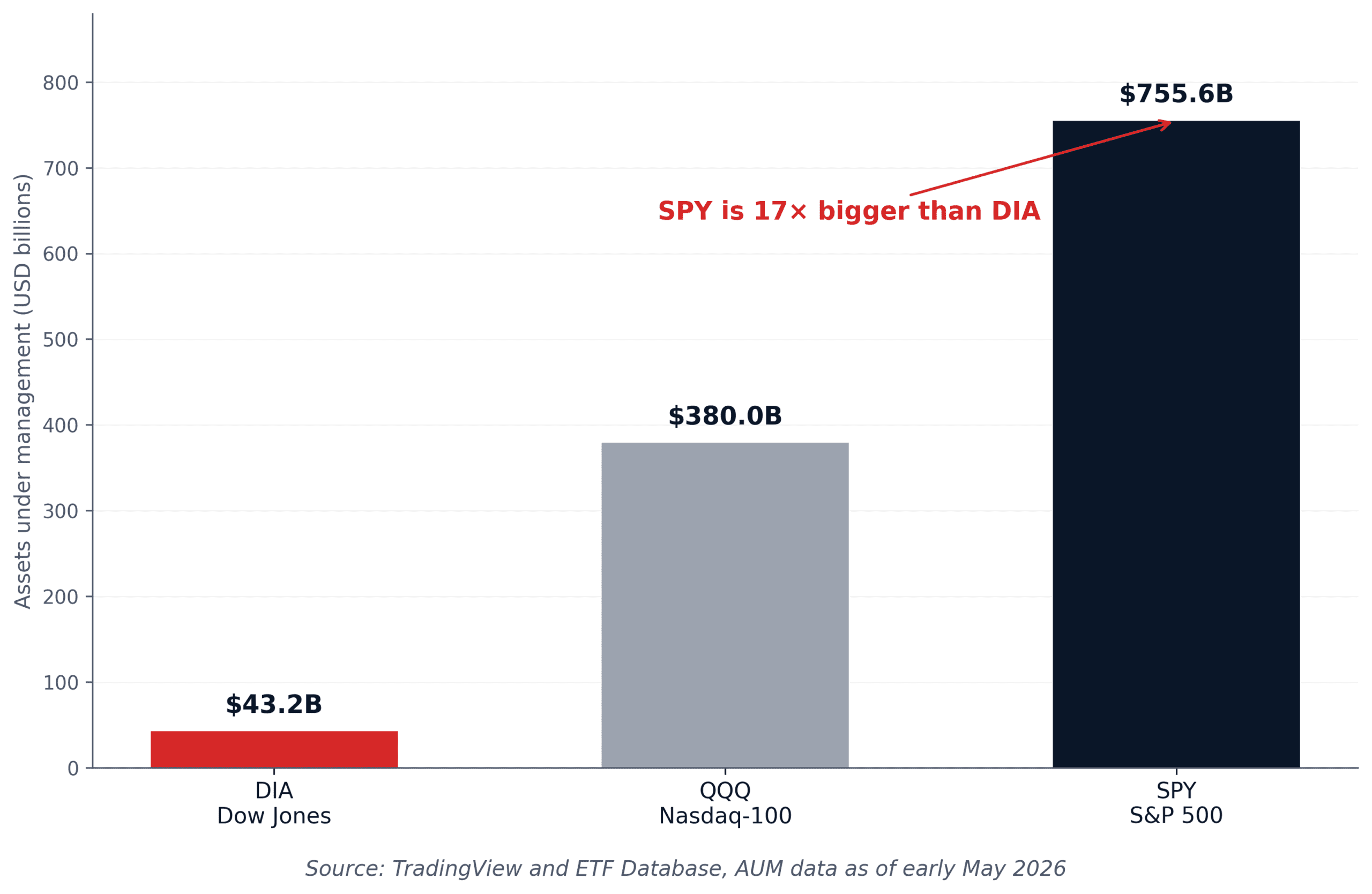
This isn’t because S&P 500 marketing is louder. It’s because most professional investors quietly stopped using the Dow as a serious benchmark decades ago. As Jonathan Golub, RBC Dominion Securities’ chief equity strategist, has put it in research notes, “we’re generally not big fans of the Dow.” The Globe and Mail described the Dow’s price-weighted methodology as “archaic” and noted that mainstream institutional money has long since migrated to S&P 500 trackers.
The two indexes also overlap less than people think. The S&P 500 holds about 35% in technology. DIA holds about 20%. That’s because the Dow is hand-picked by committee (yes, an actual committee at S&P Dow Jones Indices decides which companies are “Dow-worthy”), and the committee leans toward old-economy industrials, financials, and healthcare.
The Dow Jones ETF isn’t the safer or simpler version of the S&P 500. It’s a different bet, with worse diversification, narrower sector exposure, and a price-weighting quirk that no rational person would design today.
That said, performance-wise the two indexes have tracked closely over long periods. The Dow can outperform during turbulent stretches (it beat the S&P 500 by roughly 12 percentage points from 2000 to 2010, thanks to its tilt toward bigger, older companies). It tends to lag during tech-driven bull runs.
You’re not making a catastrophic mistake by buying DIA. You’re making a slightly worse one than buying VOO or SPY, with no obvious upside.
How to buy a Dow Jones ETF from the US, UK, EU, India, and Africa
The Dow Jones ETF universe is US-listed by default. If you’re outside the US, you don’t simply “buy DIA” the same way. The vehicle, the platform, and the tax treatment all shift by region.
Here’s the multi-region playbook, with the specific vehicle, platform, and gotcha for each.
| Region | Vehicle | Ticker / ISIN | Where to buy | Watch out for |
|---|---|---|---|---|
| US | SPDR DIA | DIA | Fidelity, Schwab, Vanguard, Robinhood | Tax-advantaged accounts (IRA, 401k) beat taxable for long holds |
| UK | iShares Dow Jones Industrial Average UCITS ETF (Acc) | CIND / IE00B53L4350 | Hargreaves Lansdown, AJ Bell, Trading 212 (inside a Stocks & Shares ISA or SIPP) | 0.33% TER (higher than DIA), but no US estate tax exposure |
| EU | Same iShares UCITS ETF (Ireland-domiciled) | CIND / IE00B53L4350 | Trade Republic, DEGIRO, Scalable Capital, Comdirect | MiFID II rules block most US-domiciled ETFs for retail investors. UCITS is the only realistic path. |
| India | SPDR DIA via overseas account | DIA (US-listed) | Vested, INDmoney, Groww US, ICICI Direct Global | LRS cap of $250,000/year, 25% withholding on dividends, 20% TCS above ₹10 lakh |
| South Africa & Africa | SPDR DIA via offshore US account | DIA (US-listed) | EasyEquities USD, Interactive Brokers ZA | Annual offshore allowance limits (R1m single, R10m foreign capital), ZAR/USD currency risk |
US investors have it simplest. Buy DIA inside a Roth IRA or 401k and the dividends grow without the drag. DIA pays dividends monthly, which is unusual and slightly nice.
UK and EU investors mostly can’t buy DIA at all. MiFID II rules (the EU directive governing investment product disclosures) block most US-domiciled ETFs for retail clients. The Ireland-domiciled UCITS version is the only realistic path. The vehicle to look at is the iShares Dow Jones Industrial Average UCITS ETF, ticker CIND on the LSE, ISIN IE00B53L4350, accumulating share class, 0.33% TER (total expense ratio, the annual fund fee). Hold it inside an ISA or SIPP and you keep the tax shelter.
Indian investors need to use the Liberalised Remittance Scheme. Platforms like Vested, INDmoney, and Groww US handle the KYC and rupee-to-dollar conversion. You’re capped at $250,000 per financial year under LRS rules from the Reserve Bank of India, and any remittance above ₹10 lakh attracts 20% tax collected at source (you get it back when filing). Dividends from US stocks are subject to 25% withholding, claimable as a foreign tax credit under the India-US DTAA (Double Taxation Avoidance Agreement) by filing Form 67.
African investors, particularly in South Africa, typically access the Dow Jones ETF through EasyEquities USD or Interactive Brokers ZA. South African residents have an annual offshore allowance of R1 million (single discretionary) and R10 million (foreign capital allowance with SARS clearance). Currency moves matter as much as the underlying ETF here. The rand has lost roughly 60% against the dollar over the past 15 years, which has made USD-denominated holdings the strongest single asset class for SA investors regardless of the underlying choice.
The $25 starter math: what you actually own when you buy DIA
DIA trades around $495 a share as of early May 2026. That’s not pocket money.
Most brokers now allow fractional shares, so $25 buys you about 0.05 of one DIA share. Which sounds like nothing until you do the breakdown.
Per the SEC NPORT filing, that $25 stake puts roughly:
- $2.87 into Goldman Sachs
- $2.82 into Caterpillar
- $1.29 into Microsoft
- $1.14 into UnitedHealth
- $0.83 into Apple
- The remaining $16.05 spread across the other 25 names
If you’d put the same $25 into VOO (the S&P 500 ETF) instead, your top holding (Apple) would only soak up about $1.65 of the total, and 500 companies would share the rest. The full math on starter portfolios for small amounts is in my $25 plan for investing in stocks with little money.
When (if ever) a Dow Jones ETF actually earns its place
I’ve spent most of this post telling you why DIA is a weird choice. So when does a Dow Jones ETF actually make sense?
Three scenarios where it earns its slot.
One: you want a value tilt without thinking about it. The Dow’s heavy weighting toward old-economy industrials, financials, and healthcare gives you something close to a passive value play. EDOW (equal-weighted) or DJD (dividend-weighted) does this more cleanly than DIA, but the underlying intuition holds. The Dow does tend to outperform in turbulent, value-friendly markets, as it did between 2000 and 2010.
Two: you’re a dividend investor who wants a quirky-but-cheap option. DJD at 0.07% is one of the cheapest US dividend ETFs full stop, and it gives you a different sector mix than the usual SCHD or VYM. It’s a fine second slot in a dividend bucket.
Three: you’re a trader using leveraged products like UDOW (3x daily) or DDM (2x daily) for short-term directional bets. These are not investments. UDOW lost 32% in 2022 while DIA only fell 7%, then gained 33% in 2023 versus DIA’s 16%. The math of daily resets means leveraged ETFs decay if held more than a few weeks. Honest admission: I don’t trade these and I don’t know anyone who’s made money holding them for more than a quarter.
What a Dow Jones ETF should not be is your default core US equity position. That’s the structural mistake most beginners make, because the Dow gets mentioned on the evening news and the S&P 500 doesn’t.
Here’s what I’d actually do
If I were starting from $25 a week and someone asked me which US index ETF to buy:
- Buy VOO or VTI as your core. Broader, cheaper, less concentrated.
- If you want the Dow flavour, buy DJD, not DIA. Same 30 names, cheaper expense ratio, saner weighting.
- Skip the leveraged Dow ETFs entirely unless you’re an active trader who’s already losing money in other places.
Cheaper. Broader. Boring.
The Dow Jones Industrial Average is a wonderful 130-year-old artefact of financial history. It’s the index that gives reporters something to say at 4:01pm. None of that means a Dow Jones ETF deserves to be the foundation of your portfolio. The whole VTI vs VOO question, plus when each one is the wrong pick, is what I broke down in my VTI vs VOO comparison, and that’s the actual choice most beginners should be making, not “DIA or QQQ?”
Buying a Dow Jones ETF as your core US equity holding is like choosing an 1896 horse-drawn carriage because it’s the most photographed vehicle in history. Beautiful object. Wrong tool for the job.
If you still want one in your portfolio, fine. Buy DJD, hold it through a tax-advantaged account, and stop checking what the Dow did today.
The thirty stocks aren’t going anywhere. Neither is the index. The only thing that should change is whether you let it sit at the center of your wealth.
Sources
- S&P Dow Jones Indices, Dow Jones Averages Methodology (2025), spglobal.com
- SEC EDGAR, SPDR Dow Jones Industrial Average ETF Trust Form NPORT-P, January 31, 2026, sec.gov
- State Street Global Advisors, SPDR Dow Jones Industrial Average ETF Trust (DIA) product page (2026), ssga.com
- iShares, Dow Jones Industrial Average UCITS ETF factsheet, ISIN IE00B53L4350 (2026), ishares.com
- Reserve Bank of India, Liberalised Remittance Scheme master direction (2025), rbi.org.in
- Vested Finance, How to invest in the Dow Jones from India (2025), vestedfinance.com
Keep learning: browse all our investing guides.

Arpit Soni
Founder and Editor in Chief
Thewealthora was started to do one thing: take the money questions people actually ask and answer them in plain English, with the arithmetic shown and the catch stated rather than buried.