

Retirement calculator: how much you need to retire
This retirement calculator projects the pot you will have when you stop working, and the monthly income it could sustainably pay using the widely cited 4% rule. Enter your age, what you have saved and what you can save each month to find your own number.
What is the retirement calculator?
A retirement calculator projects how large your savings pot could grow by the day you stop working, then estimates the income it can pay without running dry. This planner grows your current savings plus monthly contributions at your chosen return, then applies a 4% first-year withdrawal to show a sustainable monthly income, adjusted into today's money so the figure is meaningful.
How the retirement calculator works
Pot = FV of savings, Income = Pot × 4% ÷ 12- FV: future value of your current savings plus monthly contributions
- Pot: total savings at retirement
- Income: sustainable monthly withdrawal in year one
Worked example
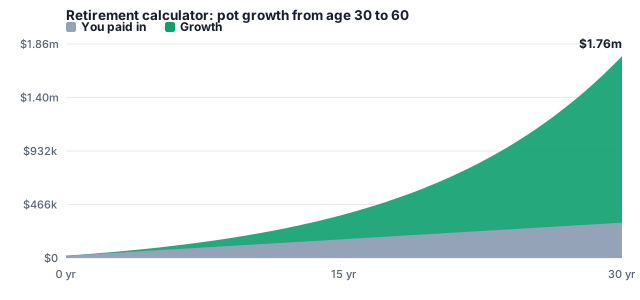
A 30-year-old with $20,000 saved, adding $800 a month at 9% until age 60, is projected to reach a pot near $1.76 million. At the 4% rule that supports about $5,860 a month in the first year, though in today's money, after 30 years of assumed 3% inflation, that feels closer to $2,400.
How to use it
- Enter your current age and your target retirement age.
- Add what you have saved and what you can save each month.
- Set an expected return and an inflation assumption.
- Read both the pot and the monthly income it can pay.
Good to know before you rely on it
- The 4% rule is a historical guide, not a guarantee. In long low-return stretches a lower withdrawal, nearer 3 to 3.5%, is safer.
- Tax-advantaged accounts change the maths. A 401k, IRA or Roth in the US, or an ISA or SIPP in the UK, shelters growth and is worth using first.
- The projection ignores state or employer pensions. If you expect one, you may need a smaller personal pot.
- Revisit the plan every few years. A pay rise, a career break or a market crash all shift the required monthly saving.
Why Thewealthora’s retirement calculator is different
- The retirement calculator translates a large, abstract total into a real monthly income you can picture.
- Shows that income in today's money, so inflation is never glossed over.
- Makes the cost of waiting visible: change your age and watch the required saving jump.
Pair it with the monthly investment calculator, the savings goal calculator, or open live markets and our investing guides.
Sources and further reading
For the underlying concepts, see the U.S. Securities and Exchange Commission on saving for retirement.
Frequently asked questions
What is the 4% rule?
It is a guideline from retirement research: if you withdraw about 4 per cent of your portfolio in year one and adjust for inflation after, your savings have historically lasted 30 years or more. It is a planning anchor, not a guarantee.
How much do I need to retire?
A quick estimate is your desired yearly spending multiplied by 25. If you want $40,000 a year, aim for roughly $1 million. This calculator does the same maths with your own numbers.
Is it too late to start at 40 or 50?
No, but the required monthly saving rises steeply the longer you wait. Run the numbers with your real age, because seeing the gap is the first step to closing it.
This tool is for education, not personalised financial advice. Results are projections based on your inputs, not guarantees.
More free tools
Keep going: check live stock market prices, read our investing guides for beginners, or catch up on today's finance news.