

Monthly investment calculator: what your plan grows to
This monthly investment calculator shows what a regular contribution could grow into, and how much of the final balance came from the market rather than from your own deposits. Investing a fixed amount every month is the simplest way to build wealth, and it removes the need to guess when to buy.
What is the monthly investment calculator?
A monthly investment calculator estimates the future value of a fixed contribution paid into a fund each month. Because you buy at every price, high and low, your average cost smooths out over time, an approach known as dollar cost averaging. The projection assumes a steady return; real funds charge an expense ratio, which this estimate does not deduct.
How the monthly investment calculator works
FV = P × ({[1 + i]^n − 1} / i) × (1 + i)- FV: final value
- P: amount invested each month
- i: monthly return rate (annual rate ÷ 12)
- n: number of monthly contributions
Worked example
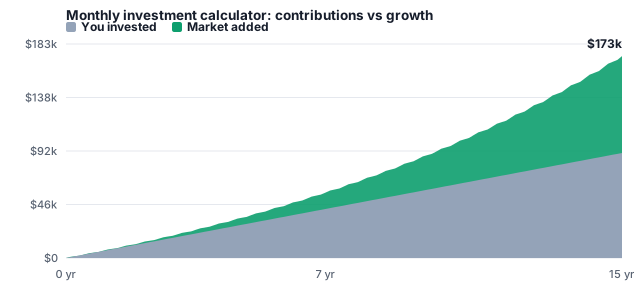
Invest $500 a month for 15 years at an assumed 8% a year. The calculator projects a final balance near $173,000, of which $90,000 is your own contributions and about $83,000 is growth. Stretch the same plan to 25 years and the growth portion more than triples, because the earliest contributions compound the longest.
How to use it
- Enter the amount you will invest each month.
- Set an expected annual return and the number of years.
- Use the inflation field to see the value in today's money.
- Read the split between your contributions and market growth.
Good to know before you rely on it
- The estimate assumes a steady return. Real funds move year to year, so treat the figure as a planning guide rather than a forecast.
- It does not deduct the fund's expense ratio. A 0.5% annual fee compounds against you the same way returns compound for you.
- Stopping and restarting breaks the compounding. The largest gains come from continuing through the falling years.
- Raising the contribution a little each year, in line with pay rises, ends far higher than a flat amount.
Why Thewealthora’s monthly investment calculator is different
- Separates what you contributed from what the market added, so the compounding is visible.
- Shows the final balance in today's money, not only as a large future number.
- Slider or keyboard entry, and it recalculates instantly.
Pair it with the compound interest calculator, the retirement calculator, or open live markets and our investing guides.
Sources and further reading
For the underlying concepts, see the SEC investor bulletin on dollar-cost averaging.
Frequently asked questions
What is a monthly investment plan?
It is an automatic contribution of a fixed amount into a fund each month. Instead of timing the market you buy at every price, high and low, which averages out your cost over time.
Is this the same as a SIP?
Yes. A systematic investment plan, or SIP, is the term used in India for the same arrangement, and the maths in this calculator is identical.
What return should I assume?
Broad stock index funds have historically returned around 7 to 10 per cent a year before inflation over long periods in the US and Europe, though past performance never guarantees the future. Use 6 per cent for a conservative view.
Can I lose money?
Yes, over short periods. Regular contributions into stock funds fall when markets fall. The approach shows its advantage over horizons of seven years or more.
This tool is for education, not personalised financial advice. Results are projections based on your inputs, not guarantees.
More free tools
Keep going: check live stock market prices, read our investing guides for beginners, or catch up on today's finance news.