Crypto capital gains tax: the “just hold it” myth that’s landing investors with surprise bills


On 17 February 2026, US crypto investors started receiving a form most of them had never seen before: the 1099-DA (the new broker tax form that reports your crypto sales straight to the IRS). For the first time, the taxman gets a copy before you even open yours.
So the old plan of “I’ll just hold and figure out the tax later” quietly stopped working. The data is already on its way to the tax office.
Crypto capital gains tax is no longer something you can ignore until April. The reporting now happens whether you file or not.Here is what most people get wrong, and what it costs them.
Crypto capital gains tax starts the second you do almost anything
The biggest myth in crypto is that you only owe tax when you cash out to your bank account. That is not how crypto capital gains tax works in the US, the UK, or most of Europe.
Tax agencies treat crypto as property, like a house or a share, not as money. The IRS digital assets rules spell this out plainly. So every time you dispose of it (sell it, swap it, or spend it), you trigger a taxable event and the difference between what you paid and what it was worth is your gain.
Think of it like a grocery receipt. Every line item is its own transaction, and the till adds them up at the end. Crypto is the same: each swap is a separate line, and the tax office wants the total.
Swapping Bitcoin for Ethereum is taxable, even though no cash hit your bank account.That single rule catches more people than anything else. You moved between two coins, felt like you “didn’t sell,” and still created a crypto capital gains tax bill in the eyes of the IRS and HMRC (His Majesty’s Revenue and Customs, the UK tax authority).
Andrew Duca, founder of crypto tax platform Awaken Tax, put the core error bluntly. He told CCN the biggest mistake by far is thinking you don’t need to file crypto taxes at all.
Short-term versus long-term: the gap that’s bigger than you think
Here is where the “just hold it” instinct is actually half right. How long you hold decides which crypto capital gains tax rate applies, and the difference is huge.
In the US, sell within 12 months and your profit is a short-term gain, taxed like your salary at 10% to 37%. Hold for more than a year and it becomes a long-term gain, taxed at just 0%, 15%, or 20% depending on your taxable income.
Those long-term bands shifted up for 2026 thanks to inflation adjustments.
The chart below shows where each rate kicks in for a single filer.
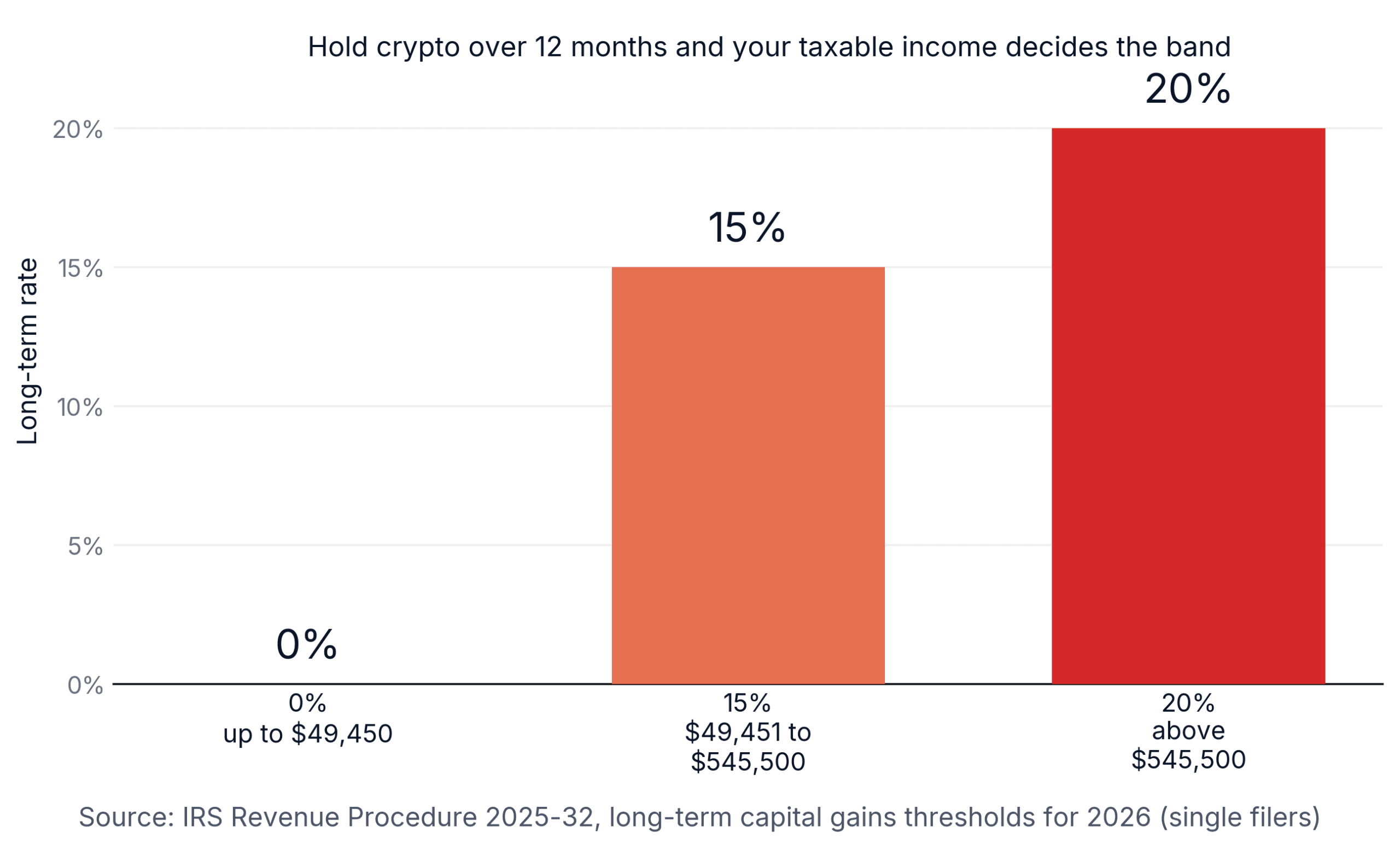
So a single filer with taxable income under $49,450 can pay nothing on long-term crypto gains in 2026. That zero-percent band is the most underused tool in crypto investing.
The UK and EU play by different rules, which is exactly where a lot of investors get blindsided. Here is the side-by-side.
| Region | How it’s taxed | Tax-free room |
|---|---|---|
| 1. United States | Short-term: 10% to 37% (like income). Long-term: 0%, 15%, or 20%. High earners add 3.8% NIIT (net investment income tax). | 0% long-term band up to $49,450 single / $98,900 married |
| 2. United Kingdom | Flat 18% (basic rate) or 24% (higher rate) on gains, regardless of holding period. Rates jumped from 10%/20% on 30 October 2024 (see gov.uk CGT rates). | £3,000 annual CGT (capital gains tax) allowance for 2025/26 |
| 3. European Union | Fragmented. Germany: tax-free if held over one year, else up to 45%. Portugal: 0% over 365 days, 28% short-term. Cyprus added an 8% flat tax from 1 January 2026. | Varies by country; Germany’s one-year rule is the standout |
Notice the pattern. The US and several EU countries reward patience with a lower or zero rate, while the UK scrapped that reward entirely. A UK investor pays the same crypto capital gains tax whether they held for a week or a decade.
The crypto capital gains tax trap hiding in your swaps and staking
This is the part the rate tables skip, and it is where the real bills come from.
Every crypto-to-crypto swap is a disposal. Every time you sold one token to buy another during a hot market, you locked in a gain or loss in the eyes of the tax office, even if your portfolio later crashed back down.
You can owe crypto capital gains tax on a profit you never withdrew and no longer have.Staking and mining are a second trap, taxed twice over. The coins you earn are income at the moment you receive them, valued at that day’s price. Then when you later sell those same coins, any further rise is a separate crypto capital gains tax event on top.
DeFi (decentralised finance, the world of lending and yield apps with no bank in the middle) makes this worse, because most tax software cannot track liquidity pools or yield farming cleanly. That gap leads to people overpaying or filing wrong without knowing it.
I’ll be honest: even tax professionals disagree on how some DeFi transactions should be classified, because the rules were written before these products existed. When the experts are unsure, the safe move is to keep every record and flag the messy ones.
There is also the 1099-DA problem. For 2025 sales, US brokers were not required to report your cost basis (what you originally paid), only the proceeds. If you trust that form blindly, the IRS may think your entire sale was profit. Your own records are the only thing standing between you and an inflated crypto capital gains tax bill. If you are still finding your feet, my crypto trading for beginners breakdown covers how to structure your first moves before the tax clock even starts.
What a $5,000 crypto capital gains tax bill actually looks like
Numbers make this real, so let’s run one. Say you bought Bitcoin for $5,000 and sold it for $10,000. Your gain is $5,000.
If you sold inside 12 months and you’re a higher-rate earner, that $5,000 gets taxed at your income rate. In the UK at 24%, that’s £1,200 gone (on a £5,000 gain). In the US, a short-term gain at the 24% bracket costs $1,200.
Hold the same position past the one-year mark in the US and it drops to the 15% long-term band: $750. Same coin, same profit, almost half the crypto capital gains tax simply for waiting.
Scale that to a $10,000 gain and the gap is impossible to ignore.
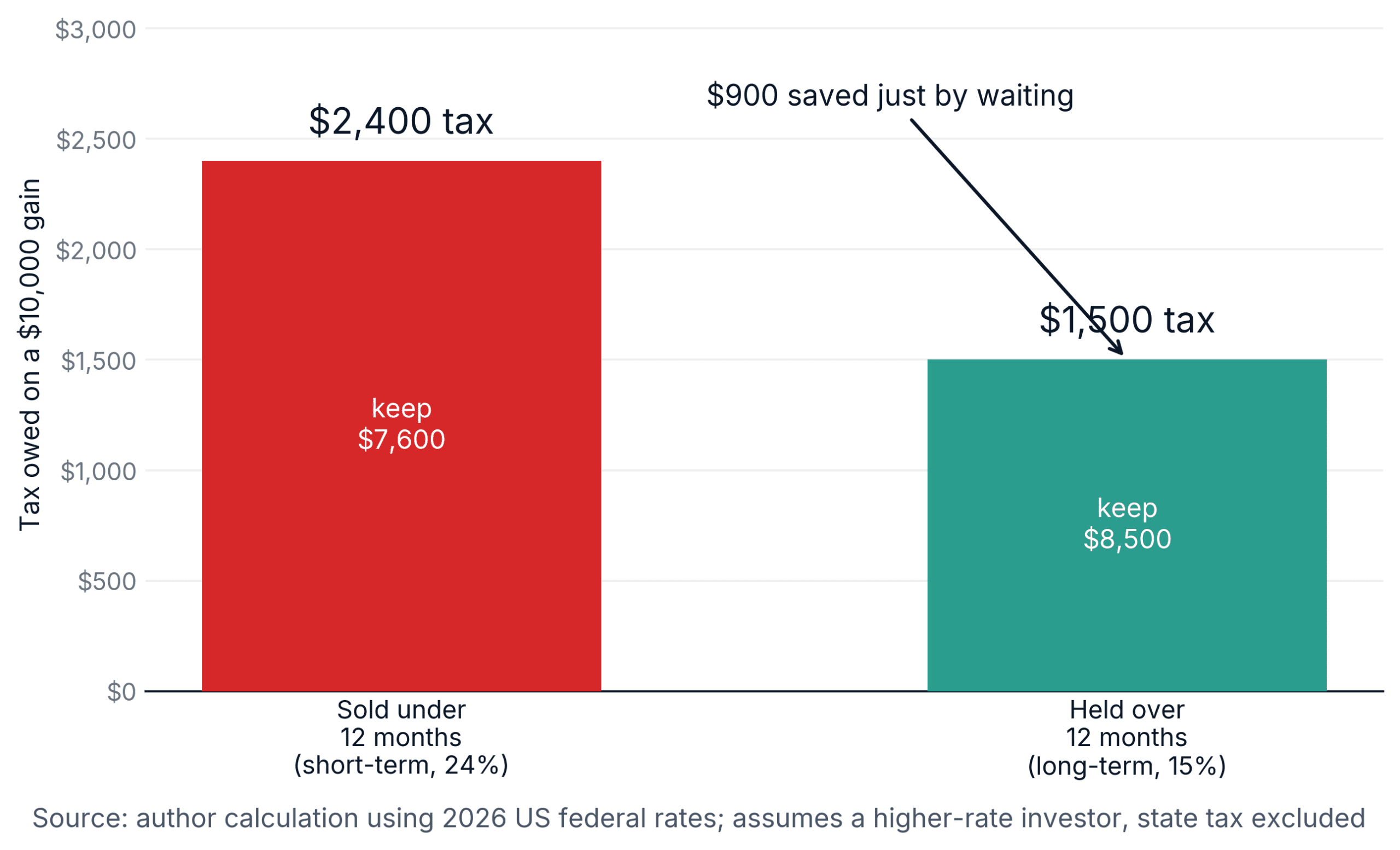
That $900 difference is not a loophole or a trick. It is the holding-period rule doing exactly what it was designed to do, which is reward investors who sit still. The catch is that it only helps you if you knew the clock was running before you sold.
UK investors don’t get this lever, which is why timing your disposal across two tax years (using two £3,000 allowances) matters far more there. A reader on r/UKPersonalFinance summed up the lesson: most people only learn the allowance resets each April after they’ve already blown through it.
How to legally shrink your crypto capital gains tax
You don’t have to leave the country or hire a Big Four accountant to pay less. A few moves do most of the work.
First, hold past 12 months wherever the long-term rate is lower, which means the US and Germany especially. Second, harvest your losses: selling a losing coin to offset a winning one cuts your taxable gain, and US investors can deduct up to $3,000 of net losses against ordinary income each year, carrying the rest forward.
Use your annual allowance every year. In the UK that’s £3,000 of gains tax-free, and it does not roll over if unused.Third, keep ruthless records. Every buy, swap, and sale with the date and price, because the 1099-DA and the UK’s new CARF (crypto-asset reporting framework, the international data-sharing rules that started 1 January 2026) mean the tax office is already cross-checking. One move worth checking: if you swap into a stablecoin thinking you’ve “parked” your profit, that swap is still a disposal. My stablecoin guide covers which coins hold their peg and how the new GENIUS Act rules affect them.
One thing not to do: assume staying under a threshold makes you invisible. Even a coffee bought with Bitcoin is technically a reportable disposal, and the reporting net now closes automatically.
Here’s what I’d actually do
Pull every transaction from every wallet and exchange into one place before you file. Check your 1099-DA against your own cost-basis records, line by line. Decide your sells around the 12-month mark and your annual allowance, not around the price chart.
Records beat regret.
The “just hold it” crowd had half the answer. Holding does cut your crypto capital gains tax in the places that reward it, but holding without records is how you end up paying tax on gains you never kept.
The market rewards patience. The tax office rewards paperwork. The investors who win at both are the ones who treat their transaction log like a receipt drawer, not an afterthought.
Your future self files in April. Be kind to them now.
Sources
- Internal Revenue Service / Revenue Procedure 2025-32, 2026 capital gains thresholds (2026), irs.gov
- HM Revenue & Customs / Cryptoassets Manual and CGT rates (2026), gov.uk
- Koinly / Crypto Tax UK and US Rate Guides (2026), koinly.io
- TokenTax / Crypto Tax Rates and 1099-DA Reporting (2026), tokentax.co
- CCN via Yahoo Finance / HMRC crypto tax warning and expert commentary (2026), finance.yahoo.com
- Kiplinger / IRS Updates Capital Gains Tax Thresholds for 2026 (2026), kiplinger.com
Keep learning: browse all our crypto and forex guides.

Arpit Soni
Founder and Editor in Chief
Thewealthora was started to do one thing: take the money questions people actually ask and answer them in plain English, with the arithmetic shown and the catch stated rather than buried.