Nvidia customer concentration risk tests earnings push
Nvidia's reliance on five hyperscalers for half its revenue is now under investor scrutiny as the chip giant tries to broaden its buyer base.
 Arpit Soni
· Published · 5 min read · ✓ Sources cited
Arpit Soni
· Published · 5 min read · ✓ Sources cited
Key Takeaways
- Nvidia earned nearly half its data centre revenue from just five hyperscalers (Amazon, Google, Microsoft, Meta, SpaceX) in the past year, raising sustainability fears
- The company is fighting nvidia customer concentration by launching a $500bn financing programme with Wall Street to let smaller firms afford GPU systems
- Investors want to see nvidia customer concentration ease, watching whether the ACIE segment (non-hyperscaler customers) can grow faster than the big five
Nvidia‘s earnings report on Wednesday will test whether the chip maker can prove it is not a hostage to five giant cloud operators, according to analysts watching what they call Nvidia customer concentration risk. The concern is real: hyperscalers (Amazon, Google, Microsoft, Meta and SpaceX) account for roughly half of Nvidia’s data centre revenue, and investors want hard evidence that smaller customers can pick up the slack.
The problem is straightforward. Nvidia became the profit engine of the AI boom by selling graphics processing units in bulk to the handful of companies with enough cash to build sprawling data centres. But that Nvidia customer concentration creates a fragility: if those five players slow their spending, Nvidia’s growth stalls. And they already are slowing.
Amazon and Google both turned cash flow negative in the second quarter. Meta’s cash generation fell more than 90% year-on-year. Both SpaceX and Tesla reported negative free cash flow as they pour money into AI expansion. The message to Nvidia investors is blunt: the hyperscalers may have hit their limit.
| Hyperscaler revenue share | About 55% of data centre revenue in past year |
|---|---|
| Q1 hyperscaler vs ACIE sales | $37.9bn hyperscalers, $37.5bn ACIE segment |
| Q1 growth rate gap | ACIE grew 31%, hyperscalers grew 12% |
| GPU financing programme | Up to $500bn from six Wall Street investment firms |
| Hyperscaler companies | Amazon, Google, Microsoft, Meta, SpaceX |
| Analysts' Q2 revenue forecast | $92.2bn total, up from prior year |
Why Nvidia customer concentration became the central question
Until May, Nvidia lumped all customers together. Then it split them: hyperscalers in one bucket, everyone else (AI clouds, industrial and enterprise firms, or ACIE) in another. That transparency revealed a jarring imbalance in Nvidia customer concentration.
In the first quarter, hyperscaler revenue hit $37.9bn against $37.5bn from ACIE. But growth told the real story. ACIE expanded 31% quarter-on-quarter, while hyperscalers grew just 12%. Taken alone, that looks reassuring. But hyperscalers still expanded 115% year-on-year, versus 74% for ACIE, meaning the big five still dominate and dominate faster.
CEO Jensen Huang framed the opportunity in May earnings: “There are only five or six hyperscalers. The rest of the industry represents 250,000 companies around the world.” Those 250,000 businesses are where Nvidia sees growth. Whether they materialise is what Wall Street will scrutinise on Wednesday.
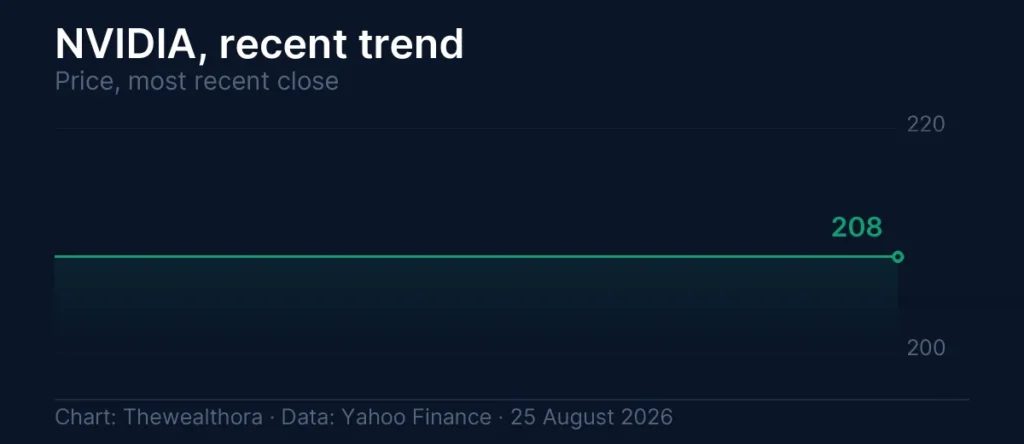
The stakes are visible in the share price. Nvidia fell 2.9% on a single Monday in recent trading, extending its losing streak to seven days, the worst run since 2022. Investors are not panicking yet, but Nvidia customer concentration anxiety is seeping in.
How Nvidia is trying to crack the smaller customer problem
The core issue is price. An Nvidia GPU system costs hundreds of millions of dollars. Few companies outside the hyperscaler tier can afford that outlay without borrowing. Nvidia’s answer is to make GPUs an investable asset, like real estate or infrastructure.
In August, Nvidia unveiled a financing programme with six leading investment banks that could mobilise up to $500bn for GPU purchases. The idea is elegant: investors buy chips knowing they generate returns through cloud rental income, so companies can borrow at lower rates secured by productive assets rather than speculative bets.
The programme is not yet detailed. Analysts say Nvidia needs to clarify how it works. But the intent is clear: Nvidia customer concentration cannot narrow without solving the cash barrier. This financing move is Nvidia trying to remove it.
The other potential relief lies in Vera Rubin, a new GPU system that has just started shipping. Huang predicted $1 trillion in sales from Blackwell and Vera Rubin through 2027. If Vera Rubin accelerates faster than expected, it could ease Nvidia customer concentration anxiety by capturing a new slice of demand from smaller firms that were priced out before.
What the earnings numbers will actually reveal about Nvidia customer concentration
Analysts expect Nvidia to report $92.2bn in total revenue for the second quarter, nearly double a year earlier. Data centre, where Nvidia customer concentration is tightest, will account for $86.3bn (94% of sales), up from 92% in Q1.
The real test is the split. Analysts forecast $43.6bn from hyperscalers (83% annual growth) and $43bn from ACIE (149% annual growth). If ACIE truly hits 149%, Nvidia customer concentration has turned. If it misses, investors will worry the smaller customer opportunity is slower than promised.
Gene Munster at Deepwater Asset Management cut to the anxiety: “The story is investors’ concern about how sustainable Nvidia’s run has been, feeling the hyperscalers just can’t give much more. They want to see the other segment starting to kick in.” That’s what Wednesday’s call will telegraph.
What this means for you
If you own Nvidia stock or an AI-focused fund, Nvidia customer concentration is no longer a background risk. It is now a live earnings metric.
- Watch the ACIE growth rate closely: if it climbs faster than hyperscaler growth for the first time, Nvidia customer concentration is genuinely easing, and the stock’s long-term narrative gets stronger
- Listen for detail on the $500bn financing programme: vague answers suggest the diversification bet is still early, keeping Nvidia customer concentration risk live through 2026 and 2027
- Track Vera Rubin shipment momentum: if a new product line can grow fast and reach different customers, it signals Nvidia customer concentration may be solvable in the medium term, rather than a structural ceiling
For a deeper dive into Nvidia’s business model and the broader AI chip market, explore Thewealthora’s guides to semiconductor investing and artificial intelligence exposure.
Original reporting on this nvidia customer concentration: CNBC.
More on nvidia customer concentration from Thewealthora
- Canada US tariff escalation: auto industry under fire
- U.S.-Canada tariffs: why trade talks collapsed
- Iran economic sanctions: why the U.S. is tightening the screw
- Gulf stock markets await Strait of Hormuz deal clarity
Originally reported by CNBC. Facts verified; analysis and wording are Thewealthora’s own.

Arpit Soni
The Thewealthora desk covers markets, money and personal finance, with zero jargon and every claim sourced.