
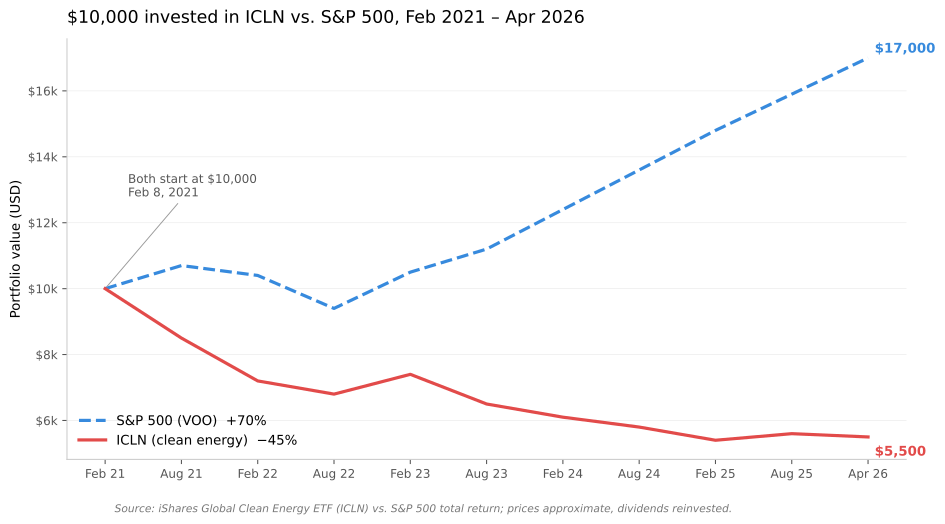
On February 8, 2021, a fund called ICLN hit its all-time high. ICLN is the world’s biggest “clean energy” fund — one investment that holds about 100 companies doing solar, wind, batteries, and the rest of the renewable energy shift.
If you’d put $10,000 into ICLN that morning, you’d have roughly $5,500 today. Over the same five years, $10,000 in the S&P 500 (the fund that holds the 500 biggest US companies) grew to roughly $17,000.
That gap is the whole story. And almost no “best clean energy ETFs” article online will show you that chart on page one.
If you want to invest in renewable energy in 2026, the right starting question isn’t “which fund should I buy?” — it’s “do I need a special fund for this at all?”
Chart comparing $10,000 invested in ICLN clean energy ETF versus the S&P 500 from February 2021 to April 2026. ICLN fell to approximately $5,500 while the S&P 500 rose to approximately $17,000.
You already own this, and don’t know it
If you own a normal, broad fund that tracks the whole market — an ETF (Exchange-Traded Fund: one investment holding hundreds of companies) like VOO, VTI, or VWRL — you’re already invested in renewable energy.
Those funds hold NextEra Energy (the world’s biggest wind and solar producer), First Solar, Enphase (makes the gadget that turns solar-panel power into the kind your house uses), plus European giants like Ørsted and Vestas.
Roughly 3–5% of a global stock fund is already in companies whose future depends on the energy transition. So the real question isn’t whether to bet — it’s whether to make your bet bigger.
The 45% drop nobody warns you about
In 2020, a US president was elected who promised big spending on renewables. Money flooded in. ICLN more than doubled in a year.
Then reality arrived. Interest rates jumped (bad for companies that borrow money to build solar farms). Cheap Chinese solar panels crushed prices. ICLN lost money in 2021, 2022, and 2023.
As ETF Stream (a UK fund news site) put it: “INRG notched up its third straight year of negative returns.” (INRG is the UK version of ICLN — same idea.) Even Lyn Alden, a well-known finance writer, LINK to her old article: “Renewable energy stocks… became overvalued.”
ICLN is also bouncier — about 1.5× as volatile (financial-speak for “moves up and down harder”) as the S&P 500. Bigger wins, much bigger losses.
Three ways in, by where you live
EU readers: You can’t buy US-listed funds like ICLN. EU rules (called MiFID II) require a specific disclosure document US funds don’t produce. Buy the European version, INRG, instead — same companies, different legal wrapper.
| Approach | US | UK | Europe |
|---|---|---|---|
| 1. Easy: buy a broad global fund — renewables are already inside | VTI, VOO (in your Roth IRA / 401k) | VWRL, VUSA (in your ISA / SIPP) | IWDA, VWCE (in your Sparplan) |
| 2. Tilted bet: add a small slice (5–10%) in a clean-energy ETF | ICLN (0.41% fee) | INRG (0.65%) | INRG (0.65%) |
| 3. Advanced: pick individual company stocks | NEE, FSLR, ENPH | Via US share dealing | Via US share dealing, where allowed |
Quick note on that “0.41% fee”: that’s how much the fund charges you per year. On $10,000, that’s about $41 — taken automatically, so you never see the bill. A plain market fund like VOO charges 0.03% (about $3 on the same $10,000). Lower is better.
For most people, Approach 1 is the right answer. You already own renewables through a broad fund, the fee is tiny, done.
What a small bet actually looks like
Imagine you’re 35 with $75,000 in your Roth IRA (or £75,000 in an ISA, or €75,000 in a Sparplan account). You decide to put 5% into clean energy — that’s $3,750. The rest stays in a broad global fund.
If renewables do well: averaging 6% per year after inflation for 30 years, your $3,750 grows to about $21,500 in today’s buying power.
If they underperform the market by 2% a year (the base case, honestly): you end up $6,000 worse off than if you’d just stuck with the broad fund.
The case for optimism
In 2024, the world spent $2 trillion building clean energy infrastructure — double what was spent on oil, gas, and coal combined (source: the International Energy Agency, the official body that tracks global energy). If the 2021–2023 crash was a price reset rather than a broken thesis, buying in 2026 is the opposite of buying at the 2021 peak.
Possible. Not guaranteed. Bet accordingly.
Here’s what I’d actually do
Own a broad global fund. Set it to buy more automatically every month. Don’t check the price.
If renewables excite you enough to overweight them, cap that tilt at 5% of your total investments. Pick the right fund for your country from the table. Add slowly.
If you ever find yourself Googling “why is ICLN down again” at 11pm — sell it. That’s not an investment. That’s a stressful relationship with a stock ticker.
The energy transition is real. The obvious retail way to bet on it has been rough. Own everything; add a little extra only if you can watch that little extra drop 40% without flinching.
Sources: BlackRock INRG factsheet · ETF Stream: Clean energy 2024 outlook · Lyn Alden on renewable energy investing · IEA World Energy Investment 2024 · Morningstar on clean energy ETFs
Leave a Reply